When Your AI Has Two Versions of the Truth
We recently encountered an interesting problem with an AI bot we had built for a client.
The system had been working well.
Then something changed.
New data was introduced into the system, but some of that information conflicted with data that had previously been manually entered into its context database.
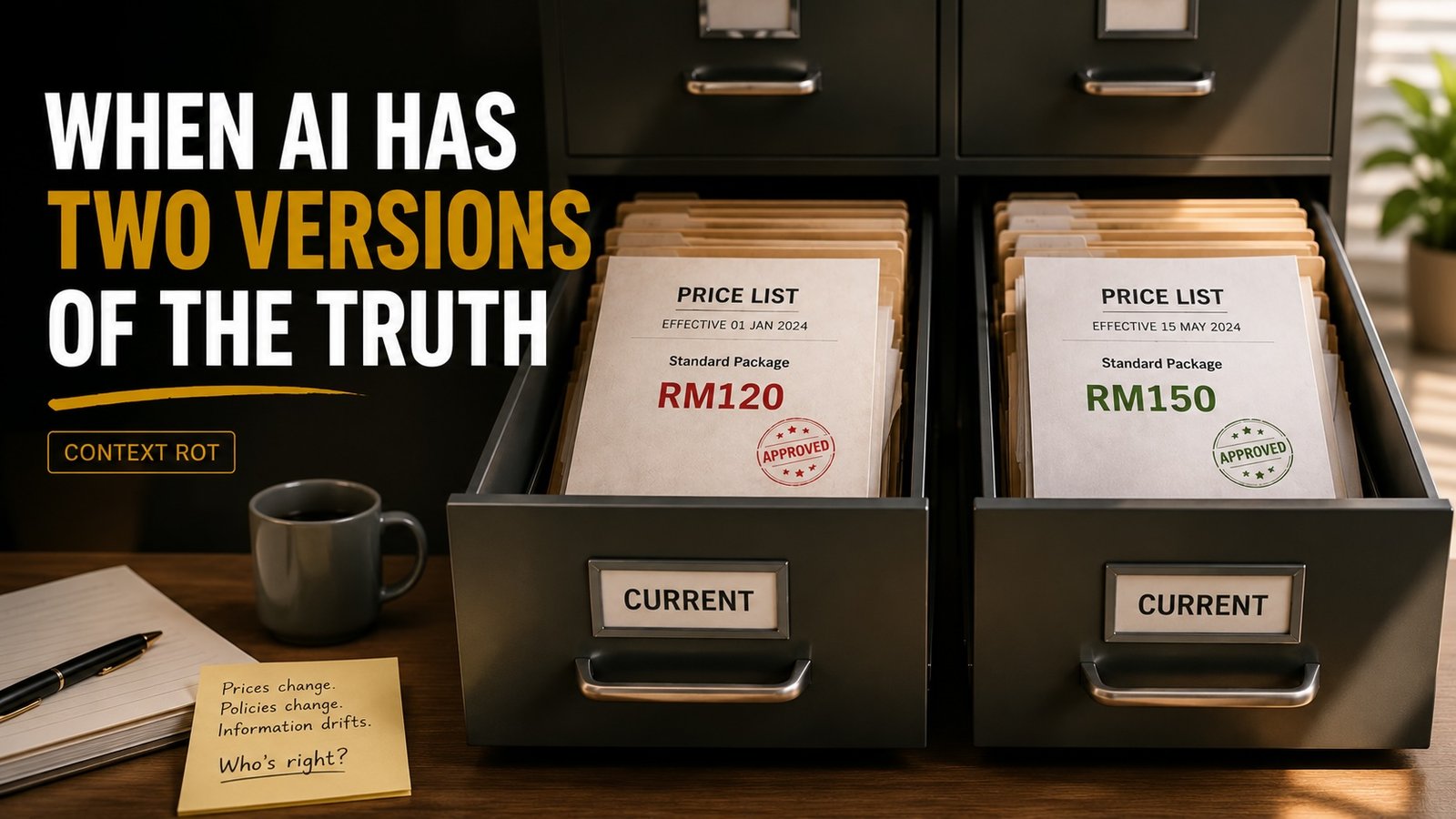
Suddenly, the AI had two versions of the truth.
When certain questions were asked, its answers became less consistent.
At first glance, it would be easy to conclude that something had gone wrong with the AI.
But the AI hadn’t suddenly become less capable.
The problem was what we were asking it to work with.
Which Answer Is Correct?
Imagine an AI encountering two pieces of information.
One source says a service costs RM100.
Another says it costs RM120.
Which one should it use?
Perhaps RM120 is the new price.
But what if the RM100 information appears in a document that looks more authoritative?
Perhaps one source was updated yesterday while another is part of an official product handbook.
Or perhaps someone manually entered the new price without removing the old one.
A human employee familiar with the business may know immediately which answer is correct.
The AI sees two plausible answers.
That’s a very different problem from the AI simply not knowing something.
It has the information.
It just doesn’t have a clear version of the truth.
This Is Where Context Starts to Rot
I’ve started thinking about situations like this as context rot.
An AI system may begin with good, carefully prepared knowledge.
But organisations don’t stand still.
Prices change.
Policies are revised.
Products are launched and discontinued.
Promotions begin and end.
Operating procedures evolve.
Employees add information.
Different departments update different systems.
Over time, new knowledge accumulates while old knowledge doesn’t always disappear.
Individually, each change may be perfectly reasonable.
Collectively, they can create contradictions.
The context that once produced reliable answers gradually becomes less reliable.
Humans Are Surprisingly Good at Working Around Bad Information
What’s interesting is that organisations may already have conflicting information without noticing it.
That’s because people are remarkably good at compensating.
An experienced employee might open an old document and immediately think:
“We don’t use that price anymore.”
Someone in operations might know that a particular policy changed three months ago even though the old SOP is still sitting in a shared folder.
A salesperson may know that the official product description doesn’t reflect how the product is currently packaged.
None of that knowledge necessarily appears in the document itself.
It comes from experience.
It is part of the Invisible Knowledge people accumulate simply by working inside an organisation.
AI doesn’t automatically have that advantage.
If we give it an old policy and a new policy without explaining which one takes precedence, we’re asking the AI to resolve an organisational contradiction that the organisation itself hasn’t resolved in its data.
Data Preparation Is Only the Beginning
We talk a lot about data preparation when organisations start AI projects.
And rightly so.
Before implementation, there is usually considerable work involved in deciding what information the AI needs.
Documents need to be gathered.
Knowledge needs to be captured.
Information needs to be cleaned.
Access needs to be considered.
Gaps need to be identified.
Ambiguity needs to be removed.
All of that helps create a strong foundation.
But our recent experience reinforced something important for me.
Good data on launch day doesn’t guarantee good data six months later.
The moment the AI goes live, the organisation continues changing.
Its knowledge needs to change with it.
Your AI Needs a Source of Truth
This is where AI management becomes an organisational issue rather than simply a technical one.
Someone needs to know:
Which information is authoritative?
Which source takes precedence when information conflicts?
Who is responsible for updating it?
What happens to the previous version?
When should temporary information expire?
How do we know when information has become outdated?
These sound like data questions.
I think they’re increasingly management questions.
Because if AI becomes part of how your organisation communicates with customers or helps employees make decisions, the quality of that knowledge directly affects the quality of the business outcome.
The More Useful AI Becomes, the More Important Maintenance Becomes
There’s an interesting irony here.
When an AI system is small and answering a handful of questions, maintaining its knowledge may be relatively straightforward.
But as it becomes more useful, organisations naturally want to give it more.
More products.
More policies.
More processes.
More customer information.
More organisational knowledge.
That increases its capability.
It also increases the amount of knowledge that needs to be maintained.
This is why I don’t think organisations should view AI as something they build, deploy and then leave alone.
The system needs an owner.
Its knowledge needs maintenance.
Its answers need monitoring.
And the organisation needs a process for learning when something has gone wrong.
AI Management Doesn’t End at Deployment
This connects to something I’ve written about before.
Going live isn’t the finish line for an AI project.
It’s the point where the system begins encountering the real organisation.
And real organisations are messy.
Information changes.
People make mistakes.
Different departments interpret things differently.
Knowledge that was accurate yesterday may no longer be accurate tomorrow.
The job after deployment is therefore not simply to keep the technology running.
It’s to keep the knowledge behind it trustworthy.
Final Thoughts
Our encounter with context rot wasn’t simply a technical problem to fix.
It was a useful reminder of what happens as AI becomes embedded in an organisation.
Preparing your data helps you get an AI project off to a good start.
Maintaining that data is what keeps the AI useful as the organisation changes.
The more businesses depend on AI, the more important that discipline will become.
Because when an AI gives the wrong answer, the instinct is often to blame the AI.
Sometimes we should look behind it first.
The AI may simply be reflecting the different versions of the truth we’ve given it.
AI knowledge isn’t something you prepare once.
It’s something you manage throughout the life of the system.