ChatGPT, Claude or Gemini? We’ve Asked This Question Before
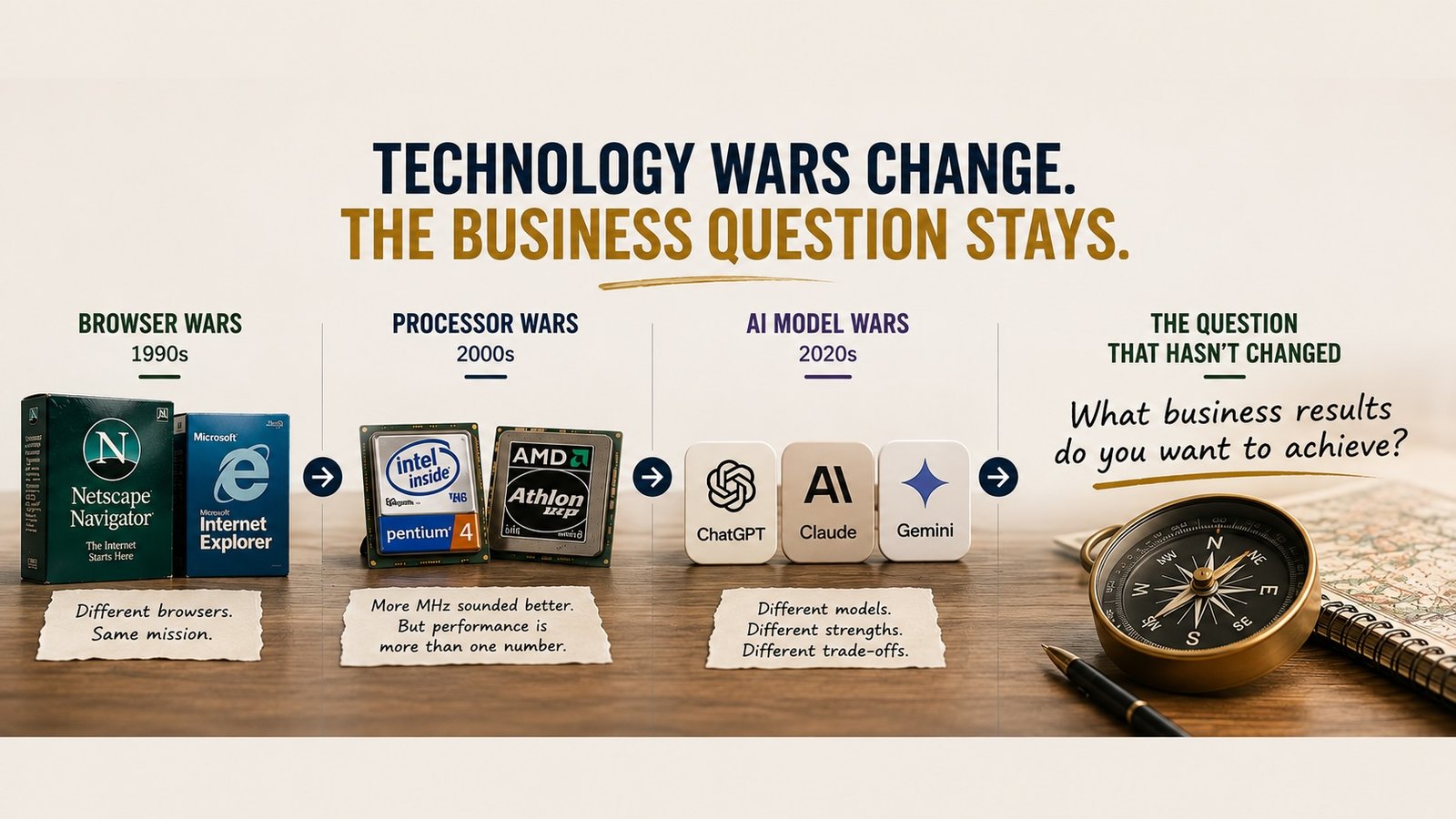
I’m old enough to remember the browser wars.
In fact, at one point in my career, I actually sold Netscape browser licences.
There was Netscape Navigator. Then Internet Explorer arrived. People debated which browser was faster, which was better and which would eventually dominate.
I also remember another technology debate from that era.
How many MHz does your computer have?
Processor speed became an easy way to compare computers. More MHz sounded like a faster computer and, therefore, a better computer.
Anyone who had spent enough time around computers knew it wasn’t quite that simple.
Processor architecture mattered.
Memory mattered.
Storage mattered.
Software mattered.
What you were actually trying to do with the computer mattered.
But MHz gave everyone a number they could understand.
I even co-wrote a book teaching people how to use the Internet during a time when getting online was still something that needed explaining.
So I’ve lived through a few generations of technology debates.
Which is why today’s conversations about AI sometimes feel strangely familiar.
“Which AI Model Is Better?”
It’s a question I’m increasingly hearing from business leaders.
ChatGPT, Claude or Gemini?
Sometimes another model gets thrown into the discussion.
My answer isn’t that they’re asking the wrong question.
In fact, I’m glad they’re asking it.
Because the question tells me something important.
The organisation has started thinking about AI seriously enough to consider what it should use.
That’s already progress.
I’d much rather have a conversation with a leadership team debating which AI to adopt than one that has decided AI is something it can worry about in a few years.
So when someone asks me which model is better, I don’t dismiss the question.
I use it to start the next conversation.
What Are You Trying to Achieve?
Before discussing models, I’d want to understand what the organisation actually wants AI to do.
Are you looking for an AI assistant that helps employees with their everyday work?
Do you want employees to search and work with internal organisational knowledge?
Are you trying to improve customer service?
Analyse large amounts of information?
Support your salespeople?
Automate part of an existing business process?
Build an AI agent that performs a specific task?
Those are very different requirements.
And once we understand the objective, the conversation about which AI is “better” starts to change.
We’re no longer comparing technology in isolation.
We’re comparing its suitability for a particular business outcome.
Better at What?
This is the question I think should follow every discussion about the best AI model.
Better at what?
A model may be excellent at reasoning but not necessarily be the best choice for the environment in which your employees work.
Another may integrate naturally with systems the organisation already uses.
One may perform exceptionally well for a particular task but cost significantly more when deployed at scale.
Another may offer capabilities that sound impressive in a demonstration but contribute very little to the business problem you’re actually trying to solve.
There isn’t necessarily one “best AI”.
There’s a better fit for a particular requirement.
That’s a much more useful conversation for a business to have.
The Model Is Only One Part of the System
There’s another reason I hesitate to make model selection the centre of an AI strategy.
The model is only one component.
What you give the AI matters enormously.
The quality of your organisational knowledge matters.
The context you provide matters.
The systems surrounding the AI matter.
Security matters.
Governance matters.
Integrations matter.
Cost matters.
And perhaps most importantly, the way people actually use the system matters.
You can have access to an extraordinarily capable AI model and still create a poor business outcome if everything around it is badly designed.
Conversely, you may not need the world’s most capable model to solve a relatively straightforward business problem extremely well.
That’s something we sometimes forget when the technology itself is attracting so much attention.
We’ve Seen This Movie Before
The browser wars felt incredibly important at the time.
So did processor speeds.
And they were important.
They helped shape the technology industry we have today.
But eventually something happened.
Most people stopped caring.
Nobody walks into a meeting today and proudly announces which browser they used to prepare their presentation.
Most people buying a laptop don’t make their decision solely by looking for the highest processor clock speed.
The technology matured.
Our understanding of what mattered matured with it.
I suspect something similar will happen with AI.
Today, model names dominate the conversation because we’re still early enough in the adoption cycle for the technology itself to be fascinating.
Over time, I think businesses will become less interested in which model sits underneath an AI system.
They’ll care about what it does.
Business Leaders Don’t Need to Win the Model Wars
The pace of AI development makes this particularly important.
The leading model today may not be the leading model a year from now.
A new capability can change the competitive landscape remarkably quickly.
Building your entire AI strategy around whichever company happens to have the strongest model at this particular moment creates another problem.
You risk allowing the technology roadmap to determine the business roadmap.
I think it should be the other way around.
Understand what the business needs.
Build the right architecture around that need.
Then choose the technology that best supports it.
And if a better technology emerges later, you should be able to evaluate it against the same business objective.
Your North Star remains the same even when the technology changes.
Keep Asking Which Is Better
So I don’t want business leaders to stop asking:
“Which is better, ChatGPT, Claude or Gemini?”
Keep asking.
It’s a perfectly reasonable question when you’re beginning to explore AI.
But don’t let the conversation end there.
Follow it with:
What are we trying to achieve?
What does success look like?
What knowledge will the AI need?
How will our people use it?
What systems does it need to work with?
What will it cost when we scale it?
How will we manage and govern it?
Once those questions are answered, choosing the technology becomes much easier.
Final Thoughts
I’ve watched technology change enormously over the course of my career.
I’ve seen the browser wars.
I’ve seen computers sold on MHz.
I’ve seen the Internet go from something we needed books to explain to something we barely think about anymore.
Now we’re watching the AI model wars.
ChatGPT.
Claude.
Gemini.
And undoubtedly many more to come.
The names will change.
The models will get better.
Today’s leader will eventually be challenged by something new.
That’s technology.
But the business question hasn’t changed nearly as much.
What business objectives are you trying to achieve?
That’s the conversation worth having.