Your Customers Have Told You What They Want. What Do You Do Next?
In my previous post, I wrote about using chatbot conversations as a source of customer intelligence.
Every enquiry contains signals.
What customers are interested in.
What they’re struggling to find.
What they repeatedly ask about.
And sometimes, how close they may be to making a buying decision.
But collecting customer intelligence is only useful if the organisation does something with it.
So we took the same hotel event enquiry data a step further.
Instead of simply asking AI to identify patterns, we asked it another question:
What should the hotel do about them?
From Patterns to Recommendations
One group of questions stood out around technical requirements.
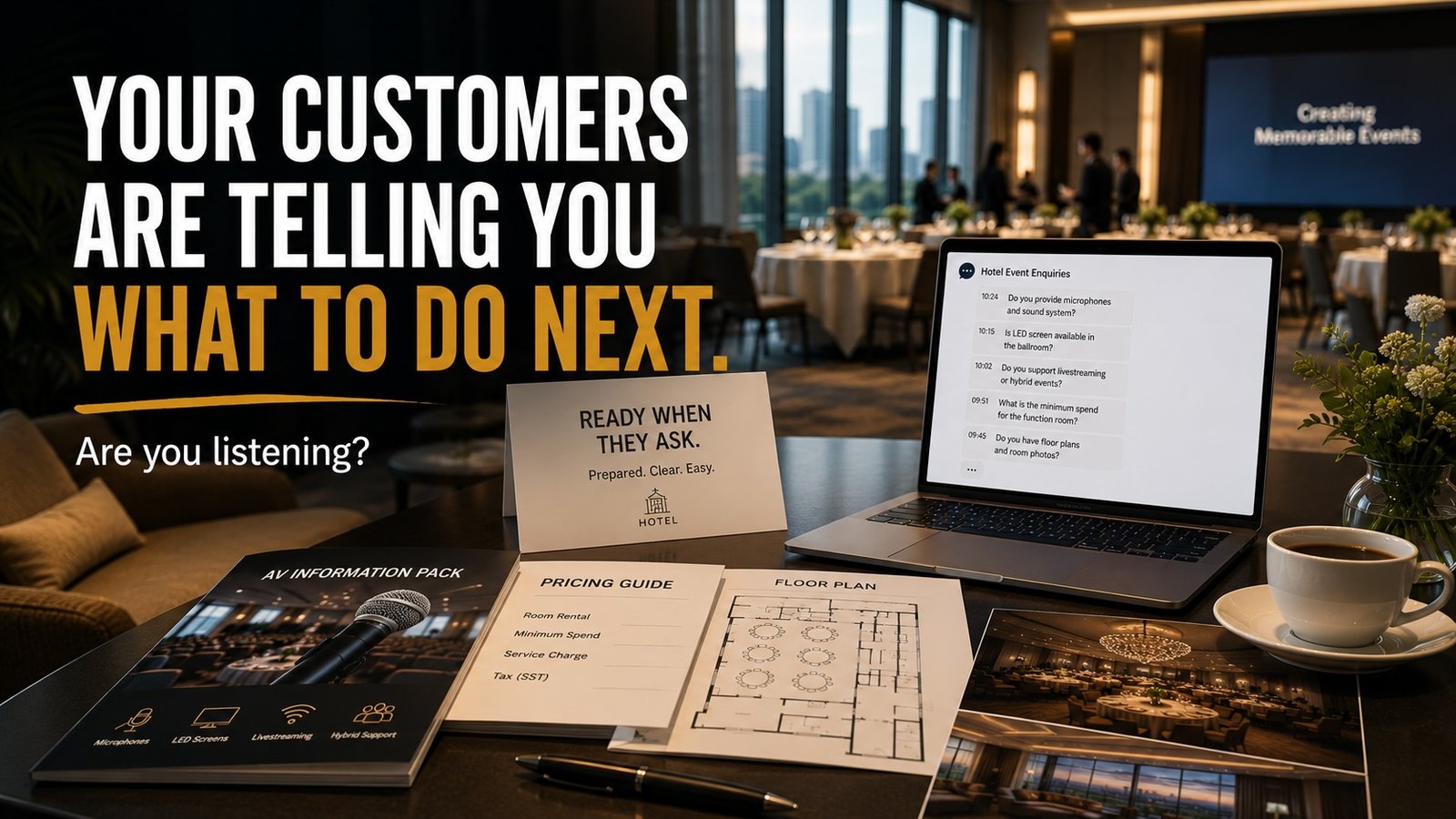
Customers were asking about AV equipment.
Livestreaming.
LED screens.
Microphones.
Projectors.
Technical support.
Individually, these are ordinary event enquiries.
But when the same subjects appear repeatedly across many conversations, they begin to tell us something.
Customers need this information as part of their decision-making process.
If that’s the case, why wait for them to ask?
Perhaps AV information should be prepared and introduced much earlier in the sales conversation.
Perhaps there should be a standard technical information pack that the chatbot or salesperson can provide immediately.
The customer gets an answer faster.
The salesperson spends less time assembling the same information.
And the hotel becomes better prepared for the next enquiry.
Pricing Questions Tell Us Something Different
Another recurring theme was pricing.
Customers wanted to understand per-pax pricing, room rental, minimum spend, service charges and tax.
Again, none of those questions is surprising.
But repetition matters.
If customers continually ask for the same commercial information, perhaps the issue isn’t simply that the chatbot needs a better answer.
It may be telling us that customers need greater commercial clarity earlier in their journey.
That’s an important distinction.
Improving the chatbot response solves the immediate enquiry.
Improving how the business presents its pricing may remove the uncertainty altogether.
Some Questions Signal Buying Intent
Site visits gave us another interesting pattern.
A customer asking a general question about an event venue may still be exploring their options.
But what about someone asking for floor plans?
Then photographs?
Then availability?
Then a viewing appointment?
Each question adds another signal.
Taken together, they may suggest that the customer has moved beyond casual research and is starting to narrow down a shortlist.
That’s valuable information for a salesperson.
If you have twenty enquiries waiting for attention, knowing which customers are showing stronger buying signals can help determine where human attention should go first.
AI isn’t making the sales decision.
It’s helping the salesperson see the opportunity more clearly.
AI Can Help Turn Customer Signals Into Action
Once these patterns are visible, AI can help translate them into practical recommendations.
For example, the hotel might:
- prepare quotation packs for the event categories generating the most demand;
- create ready-to-send AV and technical information;
- make menus, floor plans and room photographs easier to access;
- surface pricing information earlier where appropriate;
- improve chatbot responses around questions that repeatedly create friction; and
- alert salespeople when a combination of questions suggests stronger buying intent.
None of these recommendations is particularly futuristic.
That’s precisely the point.
The value isn’t in producing an impressive AI analysis.
The value is in helping the organisation decide what to do differently tomorrow.
This Takes AI Beyond Reporting
Businesses have had dashboards for years.
They tell us what happened.
How many enquiries came in?
How many leads converted?
Which month performed best?
Which product generated the most sales?
Those numbers are important.
But AI gives us an opportunity to go further because it can work with the conversations behind the numbers.
Instead of only knowing that 500 event enquiries arrived, we can start understanding what those 500 customers were actually talking about.
Then we can ask AI to help interpret those patterns.
What are customers repeatedly asking for?
Where does uncertainty appear?
What might indicate stronger purchase intent?
What information should we make easier to access?
Where should the organisation be better prepared?
Now we’re moving from:
What happened?
to:
What does it mean, and what should we do about it?
That’s a much more useful management conversation.
And the Learning Doesn’t Stop
The part I find particularly interesting is that this isn’t a one-off exercise.
New enquiries keep arriving.
Customer requirements change.
Different event categories become more popular.
New questions emerge.
Perhaps livestreaming becomes less important while another technical requirement starts appearing more frequently.
Perhaps customers begin asking about something the hotel has never offered before.
The organisation can keep learning from those changes.
This creates a cycle.
Customers ask questions.
The chatbot serves them.
The conversations generate data.
AI helps identify patterns.
The organisation responds to what it learns.
Those improvements then create a better experience for the next group of customers.
And the cycle begins again.
This Is Where AI Becomes Organisational Learning
I think this is where the conversation becomes much bigger than chatbots.
The chatbot is simply where the information is being captured.
The real opportunity is creating an organisation that learns from what customers are telling it.
That’s very different from deploying AI purely to reduce workload.
Yes, answering repetitive enquiries more efficiently has value.
But imagine if those same conversations also helped your sales team recognise better opportunities, your marketing team understand customer interests, your operations team prepare for emerging requirements and management identify where the customer experience could improve.
One AI implementation can begin creating intelligence across several parts of the organisation.
Final Thoughts
In my previous post, I wrote that the chatbot lets your customers talk to you, while the data from those conversations helps you listen.
There’s another step after listening.
You have to respond to what you’ve learned.
That’s where customer intelligence starts becoming business improvement.
Don’t simply count the conversations.
Learn from them.
Use the patterns to prepare better.
Use them to remove friction.
Use them to help your people focus their attention where it creates the most value.
Then keep listening as the market changes.
Because the chatbot isn’t only serving your customers.
The conversations are helping your organisation learn how to serve them better.