
AI Doesn’t Struggle With Knowledge. It Struggles With Ambiguity.
One of the most interesting conversations I had with a client recently wasn’t about prompts.
It wasn’t about which AI model to use.
It wasn’t even about technology.
It was about ambiguity.
We were reviewing the knowledge that would eventually guide their AI assistant.
At first glance, everything looked fine.
Then we came across a simple sentence describing the distance between the hotel and a nearby attraction.
“About 10 minutes away.”
Nobody in the room questioned it.
After all, that’s exactly how most of us would describe it.
But then I asked a simple question.
“Ten minutes by what?”
Walking?
Driving?
Cycling?
What if there’s traffic?
What if the guest is travelling with young children?
Suddenly, a sentence that felt perfectly normal became surprisingly vague.
So we changed it.
Instead of saying:
“About 10 minutes away.”
We wrote:
“350 metres from the hotel.”
Now the guest could decide whether they wanted to walk or drive.
More importantly, the AI no longer had to guess.
The knowledge had become unambiguous.
Humans Fill in the Gaps Without Realising It
That conversation reminded me of something we often take for granted.
Humans are incredibly good at dealing with ambiguity.
We make assumptions.
We read between the lines.
We infer meaning from context.
We combine experience with incomplete information and somehow arrive at the right conclusion.
It’s something we’ve spent our entire lives doing.
Most of the time, we don’t even realise we’re doing it.
When someone says a café is “just around the corner”, we don’t expect an exact measurement.
When a hotel says it’s “close to the airport”, we instinctively understand that “close” is relative.
Human communication is full of approximations, shortcuts and shared assumptions.
And for conversations between people, that’s usually enough.
AI Doesn’t Have That Luxury
AI approaches information very differently.
It doesn’t know which assumptions are safe to make.
It doesn’t understand which details are implied and which ones are important.
It can only work with the knowledge it’s been given.
If the knowledge is vague, the answers become inconsistent.
If the knowledge is precise, the answers become reliable.
That’s why preparing knowledge for AI is very different from writing for people.
It’s not about using more complicated language.
It’s about removing unnecessary ambiguity.
AI Reveals What Organisations Have Never Written Down
This is something I’ve started seeing in almost every AI implementation.
The challenge isn’t that organisations don’t have knowledge.
They have plenty of it.
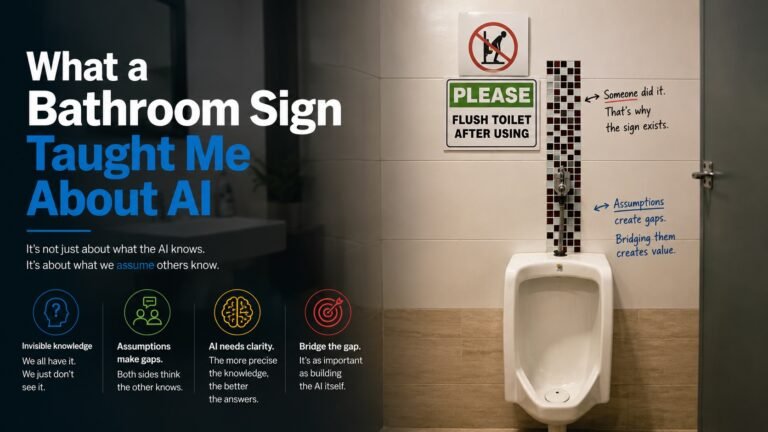
The challenge is that much of it exists only in people’s heads.
Experienced staff know that “transfer” means an airport transfer.
Reception knows that guests asking about “late checkout” usually want to know the additional charges as well.
Sales teams know which product combinations customers normally buy together.
None of this feels unusual to the people inside the organisation.
It’s simply how things are done.
Until you ask an AI to answer those same questions.
Suddenly, everyone discovers just how much knowledge has never been documented.
AI hasn’t created the problem.
It’s simply revealed it.
Knowledge Becomes a Strategic Asset
One of the biggest misconceptions about AI is that success depends on choosing the right model.
In reality, I’ve found that the quality of the knowledge matters far more.
Two organisations can use exactly the same AI technology.
One consistently delivers helpful, accurate answers.
The other produces vague or inconsistent responses.
The difference usually isn’t the AI.
It’s the quality of the organisational knowledge behind it.
That’s why I often tell clients that an AI project is also a knowledge project.
You’re not just implementing technology.
You’re making the organisation’s collective knowledge clearer, more consistent and easier to use.
That creates value far beyond the AI itself.
New employees benefit.
Customers receive more consistent information.
Teams spend less time answering the same questions repeatedly.
The organisation becomes easier to understand from the inside out.
Going Live Is Only the Beginning
This is also why I never see deployment as the finish line.
When an AI goes live, that’s the first time it starts interacting with real customers.
Customers ask unexpected questions.
They use different terminology.
They phrase things in ways the project team never anticipated.
Some conversations reveal missing information.
Others expose unclear policies or inconsistent documentation.
I’ve never seen those moments as failures.
I see them as feedback.
Every interaction teaches us something.
Sometimes about the AI.
More often about the organisation itself.
The Best AI Projects Never Really Finish
When a new employee joins a company, we don’t expect them to know everything on their first day.
We provide onboarding.
We answer questions.
We offer feedback.
We refine their understanding over time.
I think AI deserves the same mindset.
You can give an AI a handbook on day one.
But that doesn’t mean it has learned everything it needs to know.
It still benefits from coaching.
It still needs refinement.
It still needs better examples.
And as the organisation changes, its knowledge needs to evolve as well.
That’s why I believe successful AI projects aren’t measured by how much the AI knows on launch day.
They’re measured by how effectively the organisation continues to improve its knowledge after launch.
Final Thoughts
People often assume that implementing AI is primarily a technology challenge.
My experience has been very different.
The technology is usually the easier part.
The harder—and ultimately more valuable—work is helping an organisation express what it already knows with greater clarity.
Because humans are remarkably good at filling in the gaps.
AI isn’t.
And perhaps that’s one of AI’s greatest gifts.
It forces us to remove ambiguity, capture knowledge that has lived only in people’s heads, and become clearer about how our organisations really work.
The organisations that succeed with AI won’t necessarily be the ones with the smartest models.
They’ll be the ones that become better at making their knowledge a little clearer every day.