Should You Train Your People in AI First, or Build an AI System?
We had an interesting discussion internally at MVX this week.
If a company wants to adopt AI, where should it begin?
Should it train its employees to use AI?
Or could it achieve business results faster by building an AI system around a specific problem?
At first, the answer seems obvious.
Start with training.
Give employees access to approved AI tools. Teach them how to prompt effectively. Help them understand what AI can do and encourage them to find opportunities within their own work.
I believe there is tremendous value in doing that.
But one of our client implementations made us question whether training always needs to come first.
They Didn’t Start With AI Training
This particular client had a very specific business problem.
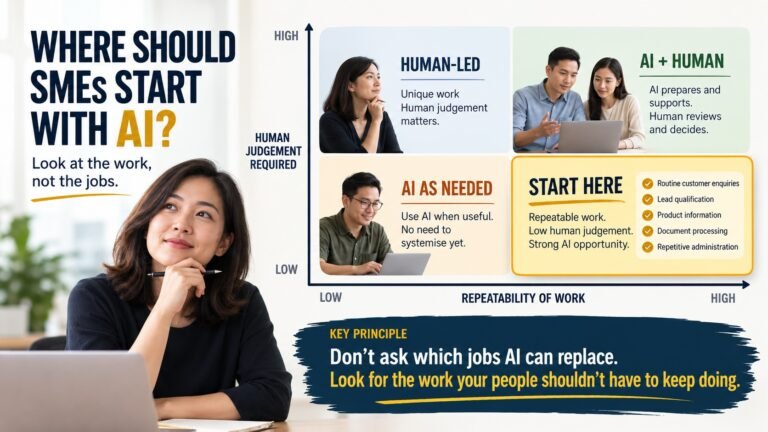
Their salespeople were receiving enquiries that needed to be qualified before they could determine which opportunities were worth pursuing.
The problem wasn’t simply the amount of work involved.
Qualification could also vary depending on who handled the enquiry.
One salesperson might ask one set of questions.
Another might approach the conversation differently.
An experienced salesperson might recognise a promising opportunity immediately, while someone less experienced could miss an important signal.
There was knowledge and experience involved in doing this well.
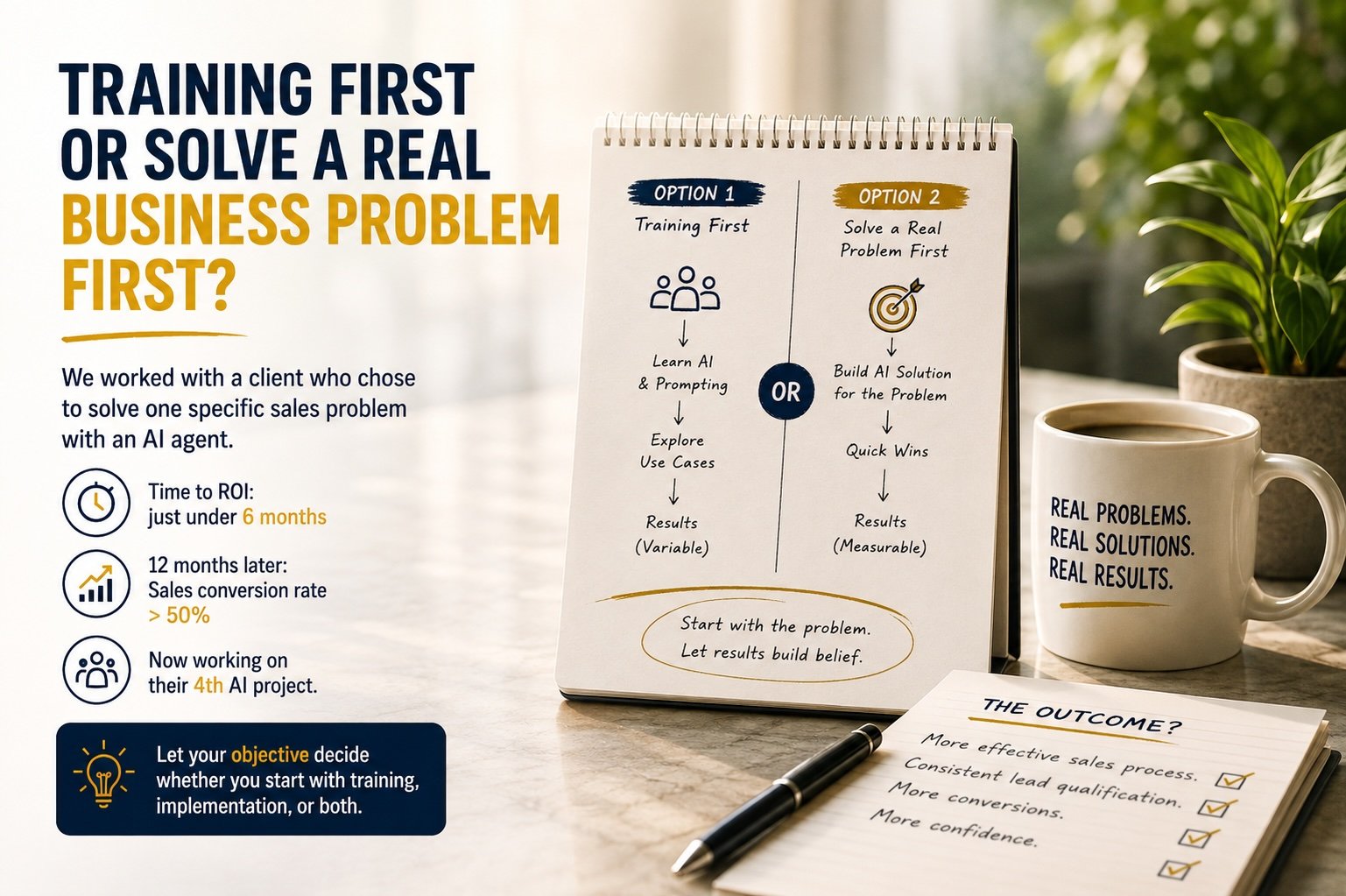
So rather than beginning with company-wide AI training, the organisation started with the business problem.
An AI agent was developed to assist with the initial pre-qualification of sales enquiries.
The AI handled the early interaction consistently, gathered the necessary information and helped determine whether an enquiry was ready to move to a salesperson.
The salesperson could then concentrate on what they did best.
Selling.
The Results Changed Our Discussion
The time to ROI was just under six months.
That alone was encouraging.
But what became more interesting was what happened as the system continued to operate and improve.
Twelve months into the project, the client is seeing a sales conversion rate of more than 50%.
There are obviously many factors that influence whether a sale closes, so I wouldn’t attribute that number to AI alone.
But better and more consistent lead qualification has helped ensure that salespeople are spending their time on better opportunities.
The AI didn’t replace the salesperson.
It improved what happened before the salesperson entered the conversation.
And that made us think differently about the question of where AI adoption should begin.
Training and Implementation Solve Different Problems
I don’t think the lesson here is that organisations shouldn’t invest in AI training.
Quite the opposite.
I’ve seen what happens when employees are given the opportunity to understand AI and experiment with it.
Training can help people become comfortable with AI.
It can help overcome fear.
It can change the way employees think about their work.
And perhaps most importantly, it can help people identify opportunities that management or an external AI consultant may never have noticed.
But training and implementation don’t necessarily solve the same problem.
Training builds capability.
Implementation solves a defined business problem.
Sometimes you need one first.
Sometimes you need the other.
And sometimes you need both working together.
Training Alone Can Create Another Challenge
There’s another consideration that I think organisations need to start thinking about.
Imagine giving hundreds of employees access to AI and telling everyone to find their own way of using it.
You’ll probably get some excellent results.
You’ll also get considerable variation.
Different prompts.
Different approaches.
Different outputs.
Different levels of accuracy.
And potentially very different standards of quality.
One employee may spend considerable time developing a very effective way of completing a task.
Another employee performing the same task may approach AI completely differently.
The organisation has adopted AI.
But it hasn’t necessarily created organisational capability.
That distinction matters.
Sometimes the Better Answer Is to Build the Good Practice Into the System
If an organisation discovers that twenty people are repeatedly performing the same AI-assisted task, I think there’s an important question to ask.
Should we continue teaching twenty people to prompt AI individually, or should we build the best approach into a system that all twenty can use?
The second option can create something training alone cannot always guarantee.
Consistency.
The organisation can determine what good looks like and embed that knowledge into the system.
Employees no longer need to reinvent the process every time they use AI.
They can focus on the judgement, relationships and decisions where their experience adds the greatest value.
This is where AI starts moving from individual productivity towards organisational transformation.
Start With the Outcome, Not the Method
The mistake would be deciding in advance:
“We need AI training.”
Or:
“We need an AI agent.”
Both statements start with the solution.
I’d rather start somewhere else.
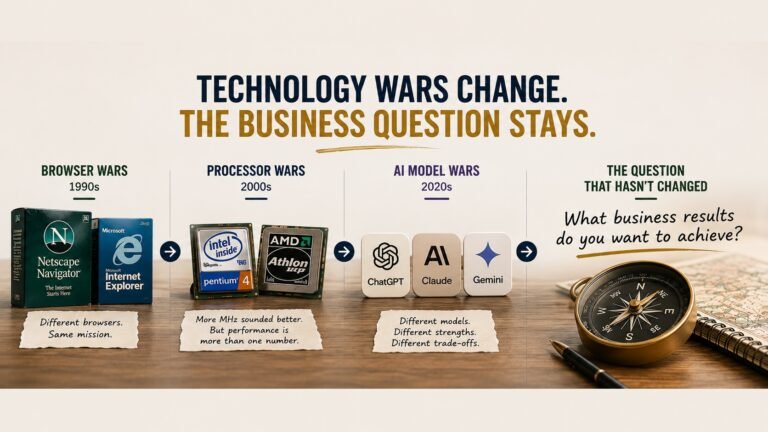
What are we trying to achieve?
If the objective is to build AI confidence across the organisation, training may be exactly the right first step.
If the objective is to improve the consistency of a sales qualification process, building a system may produce results faster.
If the objective is to discover AI opportunities across different departments, training and experimentation may reveal where those opportunities exist.
And if the organisation already knows where a significant bottleneck is, there may be little reason to wait before solving it.
The objective should determine the approach.
Successful AI Adoption Doesn’t Have One Starting Point
I don’t believe there is a universal AI adoption roadmap that every organisation should follow.
Businesses are different.
Their people are different.
Their knowledge is different.
And the problems they’re trying to solve are different.
For some organisations, the journey should begin by helping employees experience AI for themselves.
For others, the most powerful introduction to AI may be seeing a real business problem solved and measurable results delivered.
That first success can create something very valuable inside an organisation.
Belief.
People stop seeing AI as something they’re being told they should use.
They start seeing what it can actually do for the business.
From there, training becomes easier.
Adoption becomes easier.
And the conversation about the next AI opportunity becomes very different.
Final Thoughts
So, should organisations start their AI journey with training or implementation?
I don’t think that’s the first question we should be asking.
Ask instead:
What business outcome are we trying to achieve?
Then decide whether training, implementation or a combination of both is the best way to get there.
AI transformation isn’t about getting everyone to use AI as quickly as possible.
It’s about building the capability to use AI well.
And sometimes the fastest way to create that capability isn’t teaching everyone how to prompt.
It’s showing the organisation what happens when AI is applied to the right problem, in the right way, with results everyone can see.