Your AI May Not Need a Better Model. It May Need Better Context.
In my previous post, I wrote about why asking whether ChatGPT, Claude or Gemini is better is really the beginning of a much larger conversation.
The model matters, of course.
But it is only part of what determines the quality of the answer you eventually get.
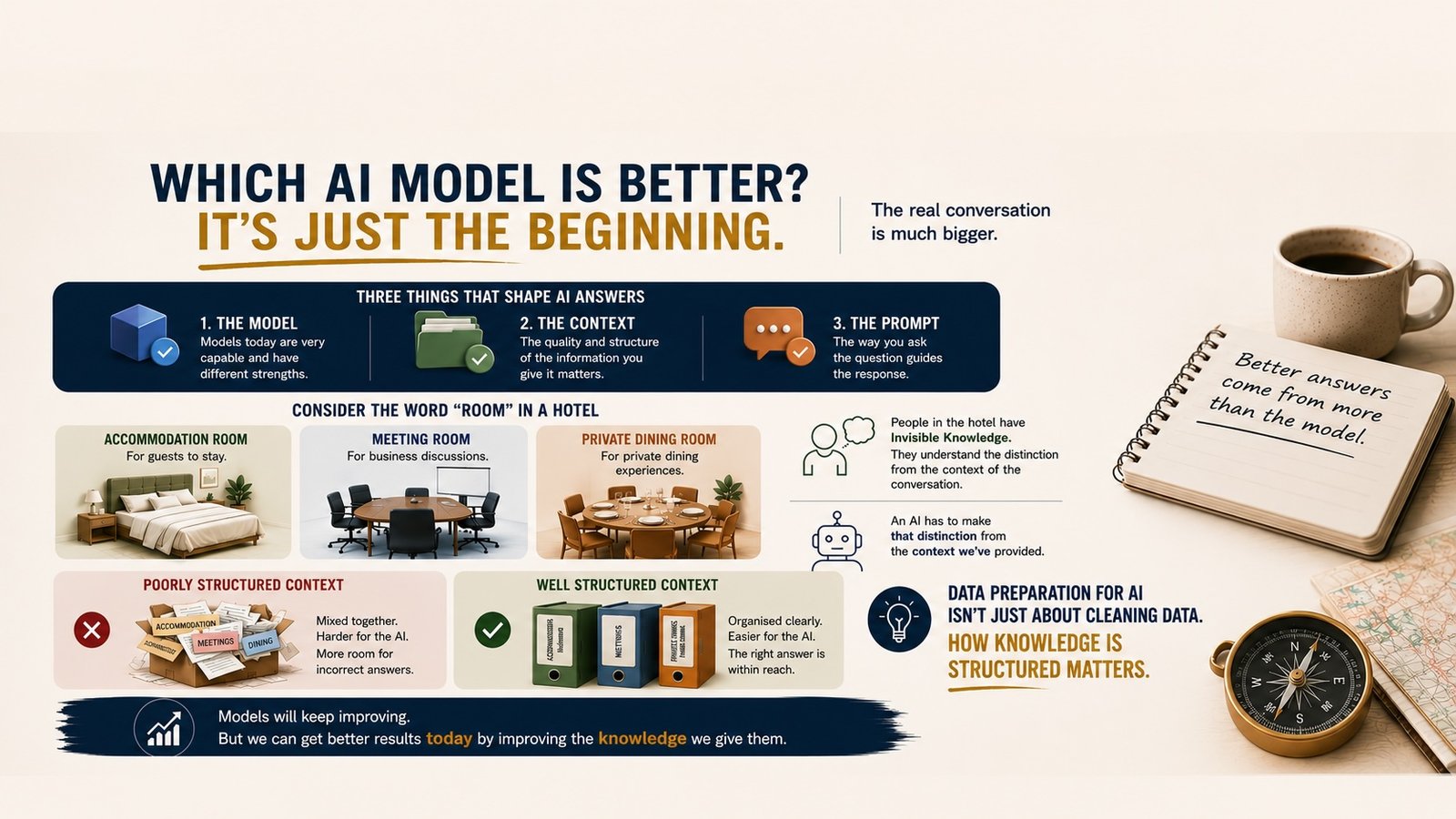
At a basic level, I think there are three things that have a significant influence on an AI’s output:
The model. The context. The prompt.
We spend an enormous amount of time discussing the first one.
Perhaps we should spend more time thinking about the second.
Models Are Already Very Capable
Different AI models still have their strengths.
Some are better suited to particular tasks. Some may reason differently. Cost, speed, integrations, security and the environment in which they’re being deployed can all influence which model makes sense.
But the reality is that today’s leading AI models are already remarkably capable.
At MVX, we’ve worked with both Chinese and Western models and have been able to achieve acceptable outputs from both.
That doesn’t mean the choice of model is irrelevant.
It means that for many business applications, changing the model isn’t necessarily the first place I would look when trying to improve an AI’s performance.
I’d look at what we’re giving it.
Context Is Where Organisations Have Considerably More Influence
The model is largely outside your control.
You didn’t train it.
You don’t determine what the next version will be capable of.
And you don’t decide when the model provider releases an improvement.
Context is different.
Your organisation determines what knowledge the AI receives.
And that gives businesses considerably more influence over the quality of their AI than they sometimes realise.
But context isn’t simply about giving the AI more information.
The quality and structure of that information matter.
Sometimes enormously.
What Does “Room” Mean?
Consider something as ordinary as the word “room” in a hotel.
Ask someone working at a hotel about a room and they’ll probably understand what you mean without giving it much thought.
But there are different kinds of rooms.
There are rooms for accommodation.
There are meeting rooms.
There may also be private dining rooms.
To someone working inside the hotel, the distinction feels obvious.
If a guest asks:
“Do you have a room for 100 people?”
the employee probably doesn’t start recommending suites.
The surrounding conversation provides enough information for them to understand that the customer is probably looking for an event or meeting space.
That’s because the employee carries a considerable amount of Invisible Knowledge about the business.
They understand how different services relate to each other.
They understand terminology.
They understand customer intent.
And they make these distinctions so naturally that they may not even realise they’re doing it.
AI Needs Us to Make Those Distinctions Clear
Now imagine giving an AI everything the hotel knows about its rooms.
Accommodation information.
Meeting packages.
Private dining menus.
Room capacities.
Room rates.
Wedding packages.
Suite descriptions.
Restaurant information.
Then imagine putting all of that into one poorly organised collection of information.
Technically, the AI has the knowledge.
But we’ve made its job unnecessarily difficult.
When someone asks about a “room”, the AI now has to determine which part of that information is relevant.
The problem isn’t necessarily that the AI isn’t intelligent enough.
The problem may be that we haven’t organised the knowledge well enough.
Structure that same information clearly and the situation changes.
Accommodation belongs under accommodation.
Meeting rooms belong under meetings and events.
Private dining rooms belong under dining.
Now there is a much clearer path between the customer’s intent and the knowledge needed to answer the question.
Same AI.
Same organisational knowledge.
Better context.
Potentially a much better answer.
More Data Isn’t Necessarily Better Data
This is one of the misconceptions I encounter when organisations start preparing for AI.
There’s sometimes an assumption that the objective is to give the AI as much information as possible.
So everything gets added.
Documents.
Presentations.
Spreadsheets.
SOPs.
Product information.
FAQs.
Marketing materials.
More information feels like more intelligence.
But imagine onboarding a new employee by giving them access to every document the company has ever produced without explaining how any of it fits together.
They technically have access to the knowledge.
That doesn’t mean they understand the business.
AI faces a similar challenge.
The objective isn’t simply to give it information.
The objective is to give it useful context.
Data Preparation Is Also Knowledge Architecture
This is why I think organisations need to broaden how they think about data preparation for AI.
Cleaning the data matters.
Removing outdated information matters.
Resolving contradictions matters.
But structure matters too.
How does this information relate to that information?
Which knowledge belongs together?
What terminology does the organisation use?
Where could the same word have several meanings?
Which information should take precedence?
What does an experienced employee understand instinctively that isn’t actually written anywhere?
These questions aren’t really about data cleaning.
They’re about understanding how organisational knowledge works.
And in many AI projects, I’ve found that this is where some of the most valuable work happens.
AI Can Expose How Well Your Organisation Understands Itself
There’s an interesting side effect to doing this properly.
You start discovering things about the organisation.
You find information that hasn’t been updated.
You discover two departments describing the same service differently.
You find policies that rely on employees knowing unwritten exceptions.
You uncover terminology that means one thing internally and something completely different to a customer.
AI didn’t create any of these issues.
They were already there.
The process of preparing knowledge for AI simply makes them visible.
And fixing them doesn’t only make the AI better.
It can make the organisation better too.
Before Changing the Model, Look at the Context
There will always be a newer AI model.
The models we’re discussing today will improve, be replaced or eventually become unremarkable.
That’s the nature of technology.
And there will certainly be situations where moving to a more capable model produces a meaningful improvement.
But I don’t think businesses should automatically assume that a disappointing AI answer means they need better AI.
Sometimes the more useful questions are:
What information did we give it?
Was that information accurate?
Was it structured clearly?
Did we provide enough context for the AI to understand what the customer actually meant?
Because those are things an organisation can improve today.
Final Thoughts
Model comparisons are useful.
Prompts matter too.
But between the model and the prompt sits something every organisation already possesses:
its own knowledge.
The challenge is turning that knowledge into context the AI can use effectively.
We’ve worked with different AI models and seen good results from them.
What increasingly interests me isn’t simply how much smarter the next model will become.
It’s how much better we can make the AI we already have by becoming better at organising what our businesses know.
Sometimes you don’t need a smarter model.
You need clearer context.