Your Customers Don’t See Your Channels. They See Your Business.
Something interesting happened to me this morning.
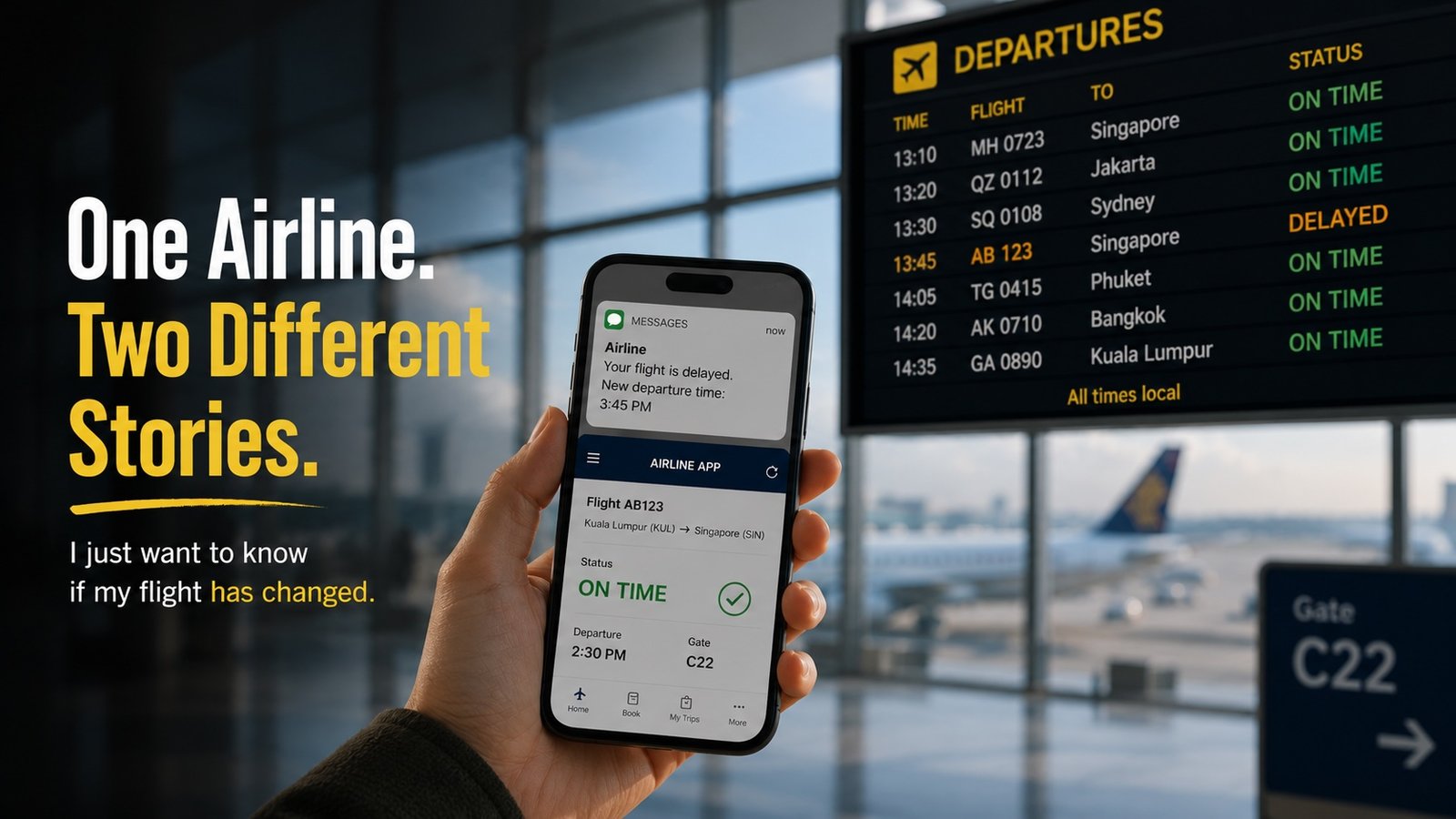
A colleague and I were travelling in different countries on different airlines. By pure coincidence, both of our flights were delayed.
A few moments later, we compared notes.
He had received a WhatsApp message and an email informing him of the delay.
I had received an SMS and an email.
So far, so good.
Then we both opened our airline apps.
Neither app showed the delay.
That was the moment I found myself thinking about something much bigger than delayed flights.
I Didn’t Care Which Channel Told Me
Not once did I stop to think:
“I wonder whether the airline will send me an SMS, a WhatsApp message or an email.”
I simply wanted one thing.
I wanted to know whether my flight had changed.
As customers, we don’t think in channels.
We think in outcomes.
We aren’t interested in whether one department manages the mobile app, another manages the website and a third is responsible for SMS notifications.
That’s the organisation’s structure.
Not ours.
Businesses See Systems. Customers See One Brand.
Inside most organisations, every customer touchpoint has its own owner.
The website belongs to one team.
The mobile app belongs to another.
Marketing manages email.
Customer service handles the call centre.
Operations may be responsible for WhatsApp.
Digital looks after the chatbot.
Each channel often has its own systems, processes and priorities.
From inside the business, that makes perfect sense.
But customers don’t experience your organisational chart.
They experience your business.
To them, it’s all one conversation.
When that conversation becomes fragmented, they notice.
AI Makes This Even More Important
One of the promises of AI is that it creates more natural conversations with customers.
But here’s the challenge.
If every channel operates independently, AI can end up making the experience feel even more disconnected.
Imagine asking a chatbot about an order on your website.
Then calling customer service and having to explain everything again.
Or updating your details in the mobile app, only to discover the call centre still has your old information.
Or receiving a promotional email for something you’ve already purchased because another system wasn’t updated.
None of these problems are caused by AI.
They’re caused by disconnected systems creating disconnected experiences.
AI simply shines a brighter light on them.
Customers Expect Continuity
Think about how naturally we move between devices today.
We might begin researching a product on our laptop.
Continue reading on our phone during lunch.
Ask a question on WhatsApp that evening.
Complete the purchase the following day.
We don’t think of these as separate interactions.
We think of them as one journey.
Customers increasingly expect businesses to do the same.
They expect context to follow them.
They expect not to repeat themselves.
They expect the business to remember where the conversation left off.
Whether that’s technically easy or difficult isn’t really their concern.
It’s simply the experience they’ve come to expect.
AI Should Connect the Experience, Not Create More Silos
When organisations talk about implementing AI, the discussion often centres on where the chatbot should sit.
Should it be on the website?
Should it live inside the mobile app?
Should it be available through WhatsApp?
Those are important implementation questions.
But I think they’re secondary.
A more important question is this:
Will customers feel like they’re talking to one business, or several disconnected systems?
The real value of AI isn’t that it gives customers another place to ask questions.
It’s that it has the potential to create continuity across every interaction.
When designed well, AI can become the thread that ties customer conversations together, regardless of where they begin.
Technology Should Be Invisible
One of the best compliments a business can receive is when customers don’t notice the technology at all.
They simply notice that things work.
They receive the right information.
The business remembers previous interactions.
The experience feels effortless.
Ironically, the more sophisticated the technology becomes, the less customers should have to think about it.
They shouldn’t have to wonder which system they’re interacting with.
Or which department they’re speaking to.
Or which channel contains the latest information.
They should simply feel like the business knows them.
Final Thoughts
My delayed flight wasn’t a major inconvenience.
But it was a useful reminder.
The airline saw an app, email, SMS, airport displays and announcements.
I saw one airline.
That’s a lesson every organisation should remember as it adopts AI.
Customers don’t experience your internal systems.
They experience your business.
Whether they ask a question through your website, your mobile app, WhatsApp or your call centre, they expect the conversation to continue seamlessly.
The technology behind those channels may all be different.
The experience shouldn’t be.
Because your customers don’t judge your systems.
They judge how your business makes them feel.