AI Isn’t Easily Distracted
Amazon’s decision to block Meta’s Muse AI assistant from shopping on its platform caught my attention.
Amazon says Meta had not obtained permission for Muse to access its store, that the agent did not identify itself while browsing, and that there were concerns about how customer credentials and account information could be handled. The dispute is part of a much bigger question now emerging around agentic commerce: who controls the shopping experience when an AI agent acts on behalf of the customer? :chatgpt-content-reference{index=”0″}
That’s an important discussion in its own right.
But there’s another business question underneath all this that I find particularly interesting.
What happens to digital commerce when the shopper looking at your products isn’t human?
We Designed Online Shopping for Human Attention
Think about how we shop online today.
You’re looking for a pair of headphones.
You search.
You scroll.
Something catches your eye.
Perhaps it’s positioned near the top of the page.
Perhaps the photography looks particularly good.
Perhaps there’s a discount.
Perhaps there’s a badge telling you it’s a bestseller.
Perhaps thousands of positive reviews reassure you.
Or perhaps it’s a sponsored product placed exactly where you’re likely to notice it.
Much of modern digital commerce has been designed around influencing what human beings notice.
That’s why advertising is such an important part of Amazon’s business.
And that’s also why the emergence of AI shopping agents is potentially much more significant than simply giving customers another convenient way to shop.
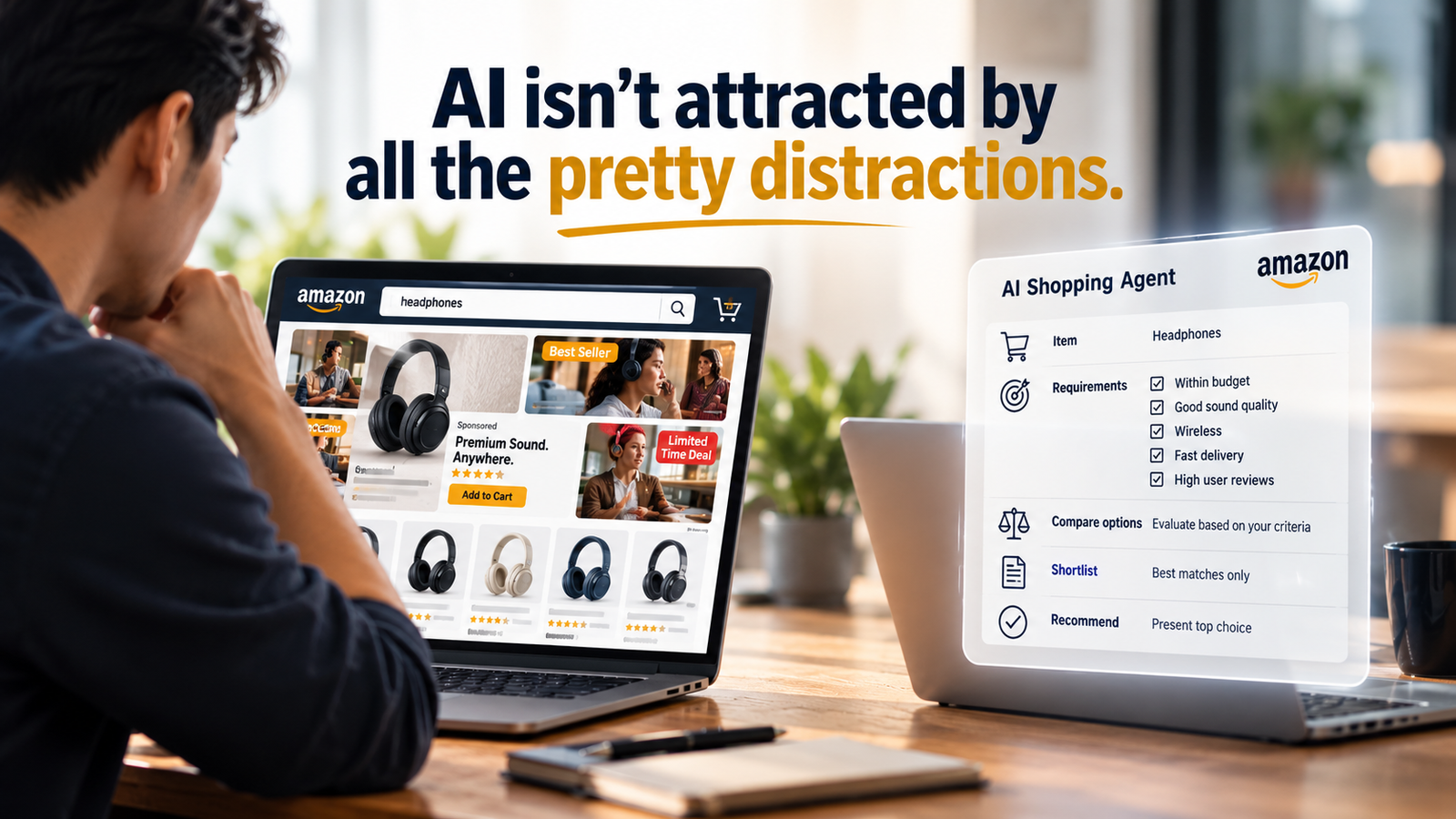
An AI agent doesn’t necessarily shop the way we do.
An AI Doesn’t Need to Browse Like You Do
Imagine I tell an AI shopping agent:
“Find me a pair of noise-cancelling headphones under RM1,000. I travel frequently, so battery life matters. They need to be comfortable for long flights, available for delivery before Friday and have consistently good customer reviews.”
The agent doesn’t necessarily need to wander through pages of products waiting for something to catch its eye.
It has a job to do.
It can compare specifications.
Check prices.
Look at delivery dates.
Analyse reviews.
Evaluate products against my requirements.
And eventually narrow the choices down.
That changes the role of the interface.
The beautiful photography is still useful for me when I make the final decision.
Brand matters.
Reviews matter.
Price matters.
Trust certainly matters.
But some of the mechanisms designed specifically to capture human attention may become less influential if an AI agent can go directly to the information it needs.
The agent isn’t tired.
It isn’t impatient.
It doesn’t necessarily get distracted by something colourful halfway down the page.
And it doesn’t necessarily care which product paid to appear first.
From Competing for Attention to Competing for Selection
For years, businesses have competed intensely for attention.
SEO helps us appear in search results.
Advertising puts products in front of potential customers.
Visual merchandising helps products stand out.
Sponsored placements give businesses more visibility.
Social media tries to interrupt the endless scroll long enough for someone to notice us.
The assumption behind much of this is simple:
If customers don’t notice you, they can’t choose you.
But AI agents potentially insert another layer between those two things.
The customer may no longer examine twenty products.
Their AI might.
The customer may only see the three products the agent decides are worth considering.
That means businesses may increasingly need to compete for something else:
selection.
Not simply:
“How do I get the customer’s attention?”
But:
“How do I become one of the products their AI decides is worth showing them?”
This Takes AI Discoverability One Step Further
I’ve written before about AI discoverability.
As customers increasingly use AI to research products and businesses, organisations need to think about whether AI can understand what they sell.
Is the product information clear?
Are specifications available?
Is pricing understandable?
Can AI determine who the product is for?
Can it distinguish one offering from another?
Can it find the information needed to make a recommendation?
Until now, I’ve largely thought about that as a discovery problem.
Can AI find you?
But agentic commerce adds another question.
Even if AI finds you, will it choose you?
Those are very different things.
Being included in the information an AI can access doesn’t guarantee being included in the recommendations it gives its user.
Your Product Data May Become Part of Your Sales Pitch
This could also change how businesses think about product information.
Humans are remarkably forgiving of incomplete information.
We can look at photographs, read a few reviews, recognise a brand and make assumptions based on experience.
An AI agent working from explicit customer requirements may need something different.
Dimensions.
Materials.
Compatibility.
Availability.
Delivery times.
Warranty conditions.
Ingredients.
Capacity.
Technical specifications.
Cancellation policies.
Whatever information matters to the decision being made.
Suddenly, structured and understandable product information isn’t simply back-office data.
It becomes part of how your product sells itself to AI.
This doesn’t mean branding and advertising disappear.
People will still have preferences. Brands create trust, identity and desire in ways that aren’t reducible to a spreadsheet of specifications.
But the balance may shift.
A product with excellent marketing but poorly structured information could become harder for an AI agent to evaluate confidently.
A lesser-known product with clear information and a strong fit against the customer’s requirements might suddenly have a better opportunity to be considered.
The Customer’s Agent Works for the Customer
There’s another reason I think this shift matters.
Traditional digital advertising largely works because businesses pay to influence what customers see.
But whose interests should a personal AI shopping agent represent?
Presumably, the person using it.
If I ask my AI to find the best product for my requirements, I expect it to work for me.
I don’t necessarily want the product that paid the most to get my attention.
I want the product that best matches what I’ve asked for.
That creates an interesting tension for platforms whose businesses have been built partly around controlling discovery, recommendations and advertising.
The Amazon-Muse dispute isn’t solely about advertising; Amazon has raised specific access, transparency, privacy and security concerns. :chatgpt-content-reference{index=”1″}
But it gives us a glimpse of a much bigger commercial question.
What happens when AI increasingly sits between the customer and the marketplace?
The Pretty Distractions Aren’t Going Away
I don’t think we’re heading towards a world where branding, design and advertising suddenly become irrelevant.
Human beings are still human beings.
We buy emotionally as well as rationally.
We have favourite brands.
We respond to stories.
We care how products look.
And sometimes we buy something simply because we want it.
AI isn’t going to remove all of that.
But it may change an important part of the buying journey.
If AI increasingly does the initial searching, comparing and shortlisting for us, then some of the battle for customer attention may happen before the customer ever sees the product.
And the first audience a business needs to convince may not always be human.
That’s why I think AI discoverability is going to become a much bigger business issue than simply appearing in an AI search result.
The question used to be:
Can customers find you?
Then it became:
Can AI find and understand you?
Agentic commerce adds the next question:
Will AI choose your product or service?