It’s Only A Chatbot
Thinking It’s Only a Chatbot is A Missed Opportunity
Whenever I hear someone say, “It’s only a chatbot.”
I know we’re about to have two very different conversations.
One conversation is about technology.
The other is about business.
Most people see a chatbot as something that answers questions.
And they’re right.
It does.
But if that’s all you think it does, you’re leaving an enormous amount of value on the table.
Every Conversation Is Telling You Something
Think about the questions customers ask your chatbot every day.
They’re not random.
Every question represents a moment where a customer is trying to achieve something.
Sometimes they’re looking for information.
Sometimes they’re comparing products.
Sometimes they’re confused.
Sometimes they’re frustrated.
Sometimes they’re ready to buy.
Every one of those conversations is a signal.
Collectively, those signals tell a story about your business.
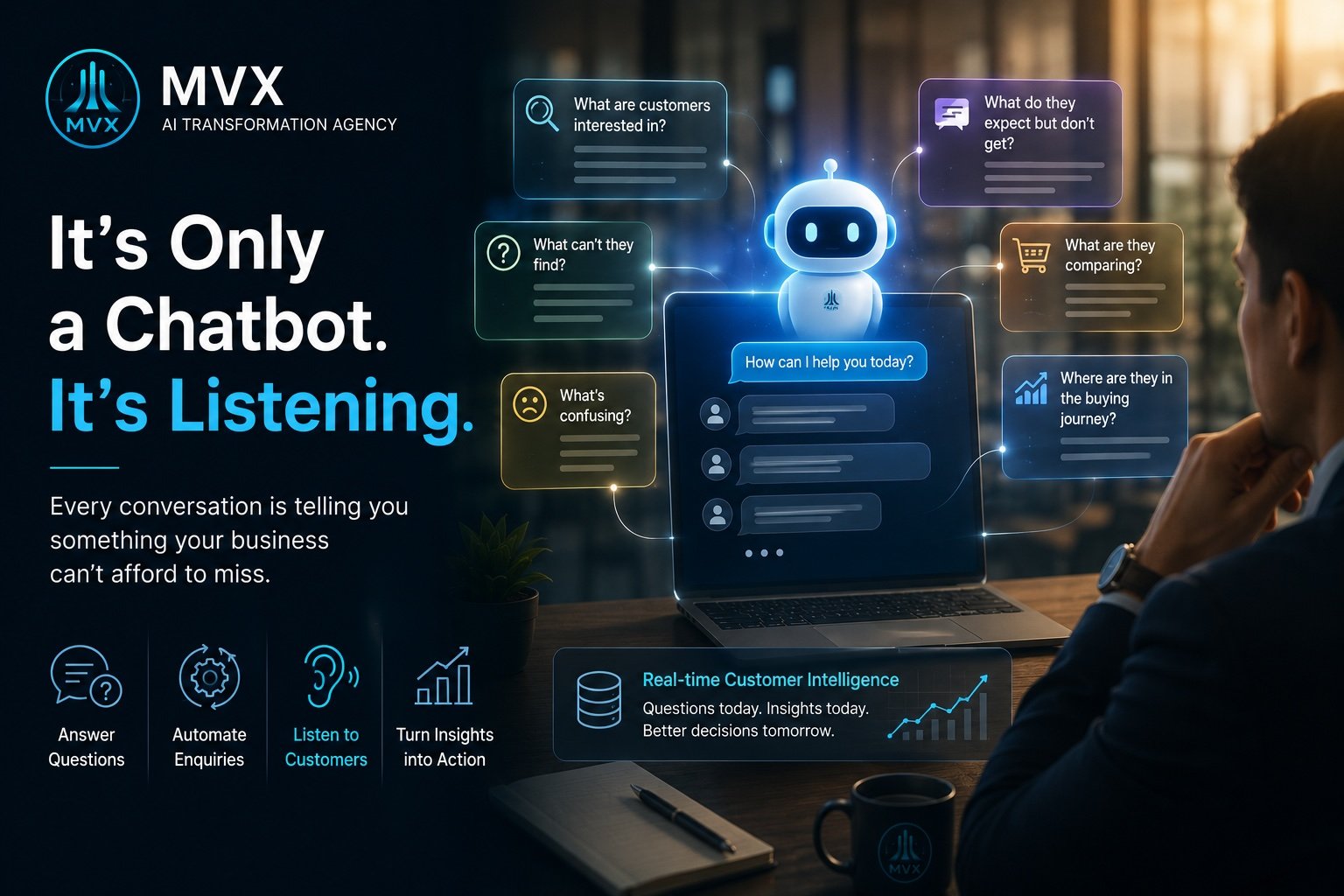
They’re telling you:
- What customers care about.
- What they can’t find.
- What they’re confused by.
- What information is missing.
- What products they’re comparing.
- Where they’re dropping out of the buying journey.
- What expectations aren’t being met.
The irony is that many companies answer the question … and then throw the insight away.
Your Customers Are Giving You Free Market Research
Businesses spend thousands of Ringgit on customer surveys.
They commission market research.
They organise focus groups.
They interview customers after a product launch.
All of these have value.
But they also have one thing in common.
They’re snapshots.
A chatbot is different.
It captures what customers are thinking today.
Not last quarter.
Not six months ago.
Not after someone has carefully considered their response to a survey.
Today.
In real time.
That’s incredibly valuable.
The Chatbot Is Listening
When people think about AI, they usually think about answers.
I think about questions.
Because questions reveal intent.
Imagine that over the course of a month your chatbot receives hundreds of enquiries asking whether a product is compatible with another product.
Perhaps your website doesn’t explain compatibility clearly enough.
Or maybe customers are interested in a bundle you haven’t created.
Suppose customers repeatedly ask about delivery to a particular location.
That might tell you demand is growing in a market you’ve overlooked.
Perhaps customers keep asking about a feature your competitors offer.
That’s not just a customer service conversation.
That’s product intelligence.
Every conversation leaves clues.
The question is whether your organisation is paying attention.
The Best Chatbots Don’t Just Answer Questions
They Help Businesses Learn
One thing we’ve learned from implementing AI solutions is this:
The businesses creating the greatest value aren’t necessarily the ones with the most sophisticated chatbot.
They’re the ones that have built processes around what the chatbot is hearing.
They review recurring questions.
They identify emerging patterns.
They notice changes in customer behaviour.
They use those insights to improve products, services, marketing, operations and customer experience.
The chatbot isn’t simply reducing workload.
It’s helping the organisation become smarter.
Customer Conversations Shouldn’t End With Customer Service
Imagine if every conversation automatically highlighted:
- Frequently asked questions that don’t exist on your website.
- Products customers struggle to understand.
- Features customers repeatedly request.
- New buying trends.
- Seasonal demand changes.
- Common reasons customers hesitate before purchasing.
Now imagine your sales, marketing, operations and product teams receiving those insights every week.
The chatbot has suddenly become much more than a support channel.
It has become a business intelligence platform.
AI Should Help Businesses Listen Better
When people ask me about AI, they often focus on automation.
How many enquiries can it answer?
How much time can it save?
How many staff can it replace?
Those are reasonable questions.
But I think a more interesting question is this:
“What is AI helping us learn about our customers?”
Because organisations that listen well make better decisions.
They build better products.
They deliver better customer experiences.
They adapt more quickly to changing markets.
And AI gives us an opportunity to listen at a scale that simply wasn’t possible before.
The Conversation Doesn’t End With the Answer
A chatbot answers questions.
That’s its job.
But the real value begins after the conversation is over.
Every interaction is feedback.
Every question is market intelligence.
Every conversation is an opportunity to understand your customers a little better than you did yesterday.
Perhaps the most valuable thing about a chatbot isn’t that it speaks.
It’s that it listens.
And the businesses that learn to listen will almost always outperform those that only learn to answer.