AI Training or AI System? Start by Looking at the Work
Following the previous post, I had a conversation with a client about assessing his company’s AI needs.
He asked me a very practical question:
“When should I train my people to use AI, and when should I build an AI system?”
I thought it was a good question.
Because once you move beyond the excitement surrounding AI, organisations eventually have to decide how AI should actually fit into the way people work.
And I don’t think the answer starts with the technology.
It starts with understanding the nature of the work.
Some Work Needs People to Think
Consider strategy.
Or research.
Or developing a proposal for a customer.
There may be a process involved, but the work changes depending on the situation.
A proposal for one customer won’t necessarily look like a proposal for another. Research can lead you in an unexpected direction. A strategic problem may require someone to challenge the original assumptions before deciding what to do next.
In these situations, human judgement matters enormously.
This is where I think AI training makes sense.
You’re not trying to automate the person’s job.
You’re helping them become better at it.
Teach someone how to use AI as a thinking partner and they can use it to research, explore ideas, challenge assumptions, analyse information and develop alternatives.
But the person remains in control.
They decide what questions to ask.
They interpret the answers.
They decide what happens next.
AI expands their capability without removing their judgement.
Then There Is Work We Keep Doing Again and Again
Now consider a different kind of work.
Every time it happens, the steps are largely the same.
Information comes in.
Someone checks it.
Certain questions need to be asked.
The information is categorised.
An action follows.
Then the process starts again with the next case.
If ten employees are individually prompting AI to perform essentially the same task, I think we need to ask whether training everyone to become better at prompting is really the best solution.
Perhaps the better answer is to build the good practice into an AI system.
Instead of ten people developing ten slightly different ways of doing the same thing, the organisation can establish a consistent approach.
The AI follows the workflow.
The organisation determines what good looks like.
Employees step in where they’re actually needed.
That’s a very different use of AI.
Sales Qualification Sits Somewhere in Between
Of course, business isn’t neatly divided between work that should be done by people and work that should be done by AI.
There’s a very important area in between.
Sales qualification is a good example.
There is usually a recognisable process.
You need to understand what the customer wants.
You need certain information.
You may need to establish budget, requirements, timing or suitability.
Much of that initial work can be handled consistently by AI.
But I wouldn’t necessarily want the AI handling the entire sales relationship.
At some point, judgement becomes important.
A good salesperson notices nuances.
They understand hesitation.
They recognise opportunities that don’t quite fit the standard criteria.
They build trust.
They negotiate.
They understand when the conversation needs to go somewhere unexpected.
This is where AI + Humans becomes particularly powerful.
The AI handles the repeatable part of the process.
The salesperson handles the part that requires judgement and relationships.
You’re not deciding whether AI or humans should do the work.
You’re deciding where each creates the most value.
Two Questions Made the Conversation Much Easier
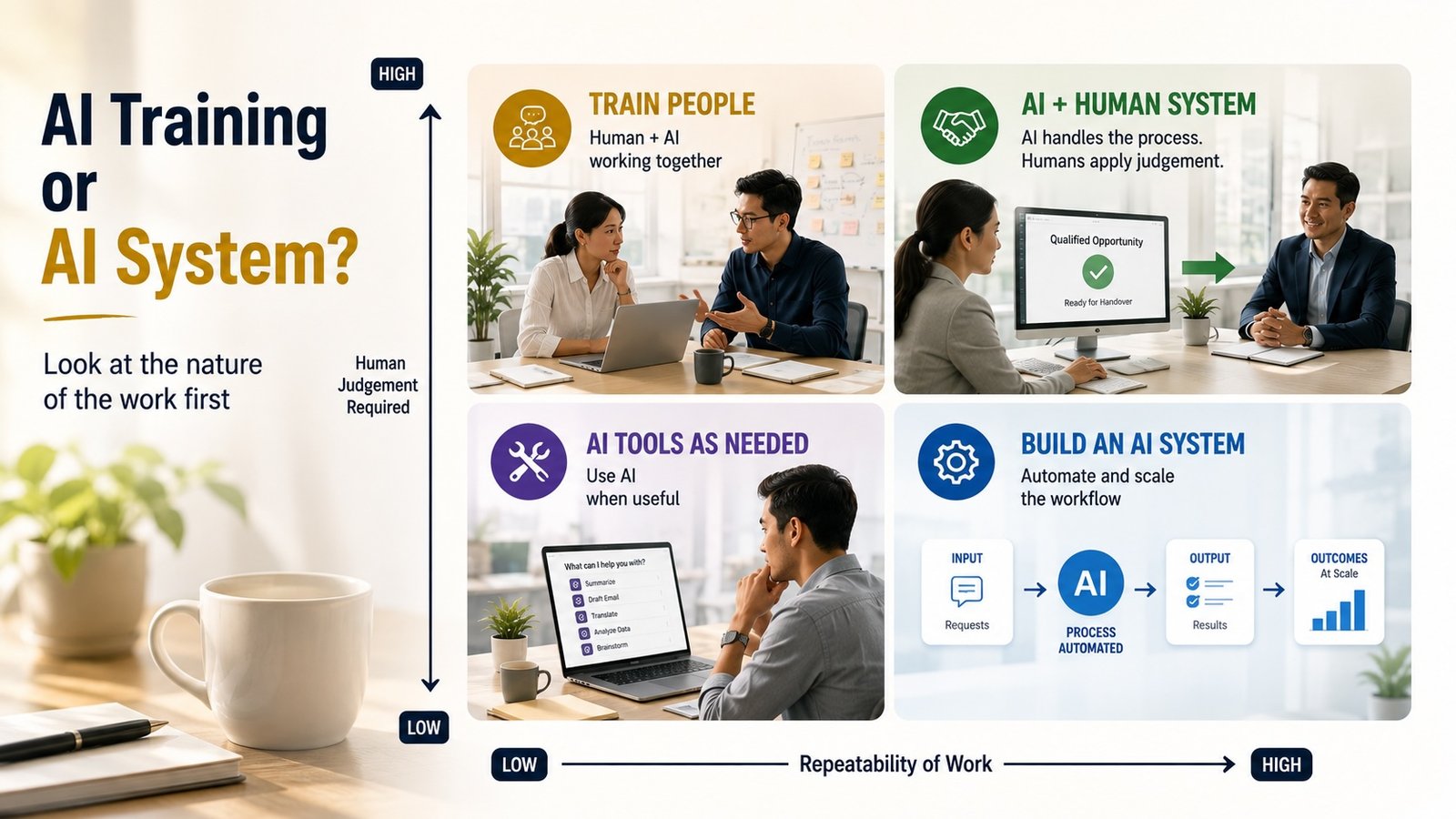
As we discussed the different types of work happening inside my client’s organisation, we eventually reduced the conversation to two questions:
How repeatable is the work?
And:
How much human judgement does it require?
Those two questions give us a surprisingly useful way to think about AI adoption.
Low Repeatability + High Human Judgement: Train People
Think research, strategy, creative work, problem solving and developing proposals.
The work changes frequently and judgement matters.
Give people the skills to use AI effectively and allow them to decide how and when to apply it.
High Repeatability + Low Human Judgement: Build an AI System
Think repetitive enquiries, standard information processing, routine classification or established administrative workflows.
If the process is already understood, there’s less value in asking every employee to reinvent it through their own prompts.
Build the process into the system.
High Repeatability + High Human Judgement: AI + Human System
This is where I think some of the most interesting opportunities exist.
Sales qualification is one example.
AI can handle the consistent, repetitive part of the workflow before handing the work to someone who applies experience and judgement.
The system doesn’t remove the human.
It makes the human contribution more valuable.
Low Repeatability + Low Human Judgement: Use AI When Useful
Not everything needs an AI strategy.
Sometimes the work is occasional, low-risk and doesn’t justify building a system around it.
Use the available AI tools when they’re helpful.
Move on when they’re not.
We shouldn’t turn every task into an AI transformation project simply because we can.
This Is Why There Isn’t One AI Adoption Roadmap
I don’t believe every company should begin its AI journey in exactly the same way.
One organisation may benefit enormously from company-wide training because much of its work depends on knowledge workers exercising judgement.
Another may have a highly repetitive process that’s already causing a measurable business bottleneck.
Training everyone first may simply delay solving a problem the organisation already understands.
And many organisations will need both.
They need people who understand how to work with AI.
They also need systems that make good AI practices repeatable and consistent across the organisation.
The question isn’t which approach is better.
It’s which approach fits the work.
Start With the Work, Not the AI
This is increasingly how I think organisations should assess their AI opportunities.
Don’t begin by asking:
“Where can we put AI?”
And don’t assume that AI adoption means everyone needs to learn how to prompt.
Look at the work first.
Where is human judgement essential?
Where is the work fluid and unpredictable?
Where are people repeatedly performing the same process?
Where would consistency make a meaningful difference?
And where would combining AI efficiency with human judgement create a better outcome than either could achieve alone?
Once you understand that, the technology decision becomes much easier.
Some work needs better AI-enabled people.
Some work needs better AI systems.
And some of the most valuable work needs both.
How repeatable is the work?
How much human judgement does it require?
Start there.
The answer will tell you far more about what your organisation needs from AI than starting with the technology ever will.