Don’t Ask Which Jobs AI Can Replace. Look at the Work Instead.
When companies start thinking seriously about AI, one question inevitably comes up.
Which jobs could AI eventually replace?
I understand why people ask it. AI can now perform tasks that, only a few years ago, we assumed required a person.
But particularly for Malaysian SMEs, I don’t think that’s a very useful place to start.
Instead of looking at jobs, I think we should look at the different types of work inside those jobs.
Because a job isn’t one thing.
The Same Person Can Be Doing Very Different Work
Take a salesperson.
They might spend an hour negotiating a complex deal with an important customer.
They need to understand the customer’s concerns, recognise when to push and when to hold back, negotiate terms and build enough trust to move the relationship forward.
Experience matters.
Relationships matter.
Judgement matters enormously.
An hour later, the same salesperson may be answering questions about product availability, specifications, standard pricing or delivery times.
Questions that the company has answered hundreds of times before.
Same employee.
Completely different work.
If we ask whether AI can replace the salesperson, we miss that distinction entirely.
A much more useful question is:
Which parts of the salesperson’s work actually need a salesperson?
Look at Repeatability and Judgement
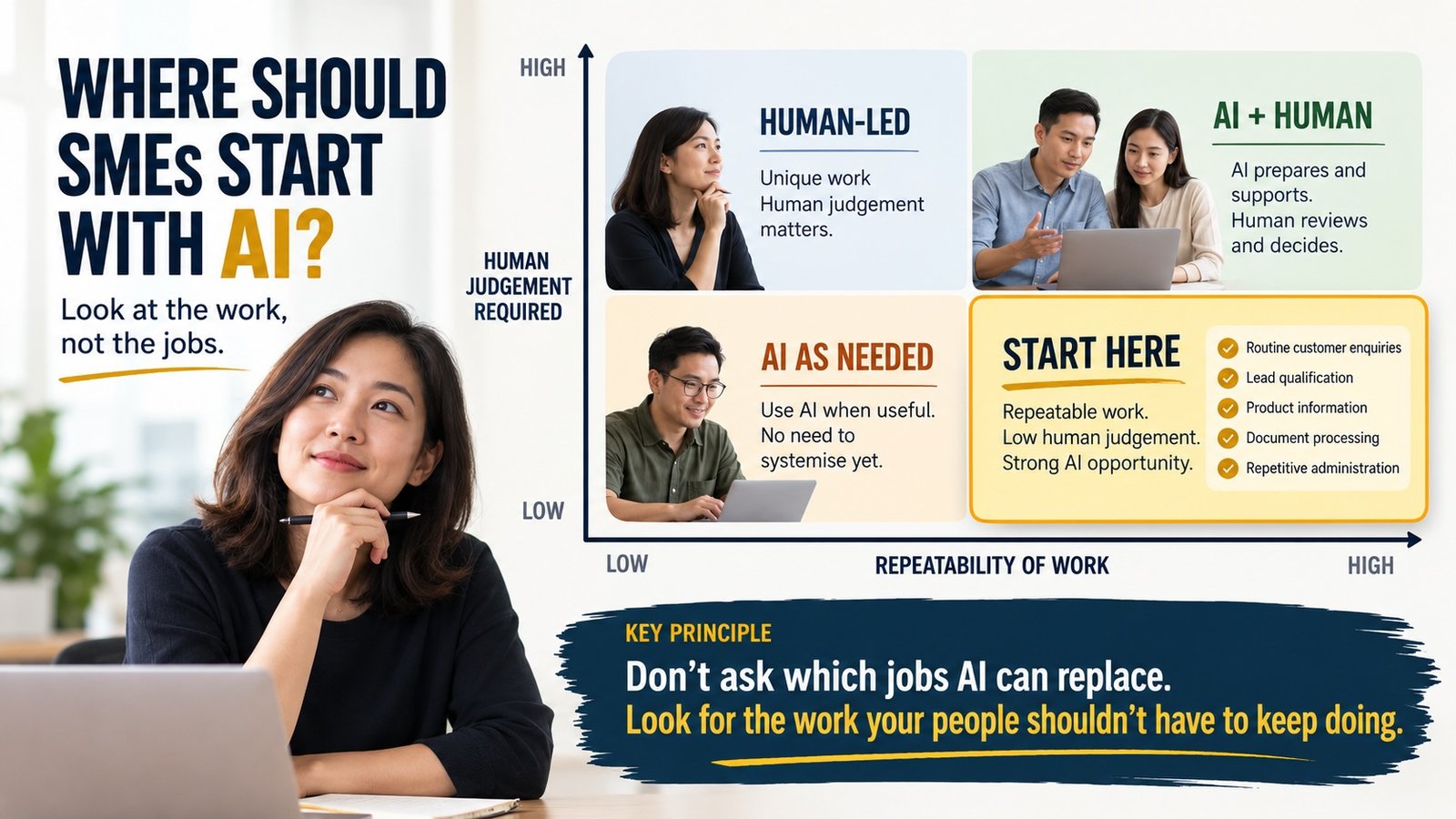
I’ve started looking at potential AI projects along two dimensions.
How repeatable is the work?
And:
How much fresh human judgement does it require each time?
Those two questions can tell us quite a lot about where AI might be useful.
Imagine work that happens hundreds or thousands of times and follows a fairly predictable pattern.
A customer asks about a product.
A lead needs to be qualified.
Information needs to be extracted from a document.
An employee needs to find a standard policy.
A routine administrative process needs to be completed.
If the work is highly repeatable and requires relatively little fresh judgement each time, it becomes an obvious area to investigate.
Not because we’re trying to remove someone’s job.
Because we’re asking whether a person should really have to keep doing that particular piece of work.
Repeatable Work Can Still Require Judgement
Of course, repeatability doesn’t automatically mean something should be handed entirely to AI.
Some work follows a recognisable process but still requires considerable human judgement.
Sales qualification is a good example.
There may be standard information that needs to be gathered.
What does the customer need?
What’s their budget?
What’s their timeline?
Are they a suitable prospect?
AI can handle much of that initial work consistently.
But eventually the opportunity may need a salesperson who can understand the nuances of the conversation and decide what to do next.
The AI doesn’t need to make the final decision.
It can gather the information, organise it and prepare the opportunity so the salesperson begins with better context.
The repetitive work moves towards AI.
The judgement stays with the human.
That’s where I think Human + AI becomes particularly powerful.
AI Can Prepare. Humans Can Decide.
The same principle applies elsewhere.
An AI might analyse a large set of information and highlight unusual patterns.
A manager decides what those patterns mean for the business.
AI might prepare several approaches to a problem.
A strategist decides which direction makes sense.
AI might produce the first draft of a proposal.
The salesperson refines it based on what they know about the customer.
AI might review hundreds of documents and surface the ones that require attention.
A person makes the decision.
In each case, we’re not choosing between AI and a human.
We’re deciding where the handover should happen.
Not Everything Needs to Become an AI System
There’s another side to this.
Some work doesn’t happen very often and depends heavily on judgement, experience or circumstances.
There may be very little reason to systemise it.
This is something I think organisations need to remember as AI becomes more accessible.
Just because AI can be involved doesn’t mean we need to build an AI system around everything.
Sometimes the best person to perform a task is still simply the person who knows how to do it.
AI should solve a worthwhile problem, not become a solution looking for one.
This Matters for SMEs
I think this way of looking at AI is particularly useful for SMEs because resources are limited.
A smaller business can’t afford to experiment everywhere simply because AI is exciting.
It needs to identify opportunities where an implementation can create meaningful value.
Look around the organisation.
Where are people answering the same questions every day?
Where is information repeatedly being copied from one place to another?
Where are employees following the same steps again and again?
Where does work pile up because someone has to perform a routine check before it can move forward?
Where are experienced people spending their time on work that doesn’t really require their experience?
Those are much more interesting places to begin.
The Goal Isn’t to Remove the Human
I think the discussion around AI and jobs has made businesses look at this from the wrong direction.
If we begin with:
“Which employees can AI replace?”
we naturally start designing around headcount reduction.
But if we begin with:
“Which work shouldn’t our employees have to keep doing?”
we start designing around capability.
That’s a very different objective.
Free a salesperson from repetitive enquiries and they can spend more time selling.
Free a manager from assembling information and they can spend more time making decisions.
Free customer service employees from answering routine questions and they can concentrate on customers who genuinely need help.
The value of AI isn’t always fewer people.
Sometimes it’s getting more value from the people you already have.
Start With the Work
For an SME looking for its first practical AI project, I wouldn’t begin by drawing up a list of jobs that might eventually disappear.
I’d start by looking at the work happening inside those jobs.
Find the things that happen again and again.
Then ask:
How much fresh human judgement is really required each time?
If the answer is very little, you’ve probably found something worth investigating.
If considerable judgement is still required, look at whether AI can prepare the work before handing it to a person.
And if the work is unusual, unpredictable and heavily dependent on experience, perhaps leave the human to do what humans are particularly good at.
A job contains many different kinds of work.
They don’t all belong on the same side of the Human + AI equation.
The opportunity isn’t necessarily to remove the person.
It’s to remove the work that prevents that person from doing what they’re really there to do.