What a Bathroom Sign Taught Me About AI
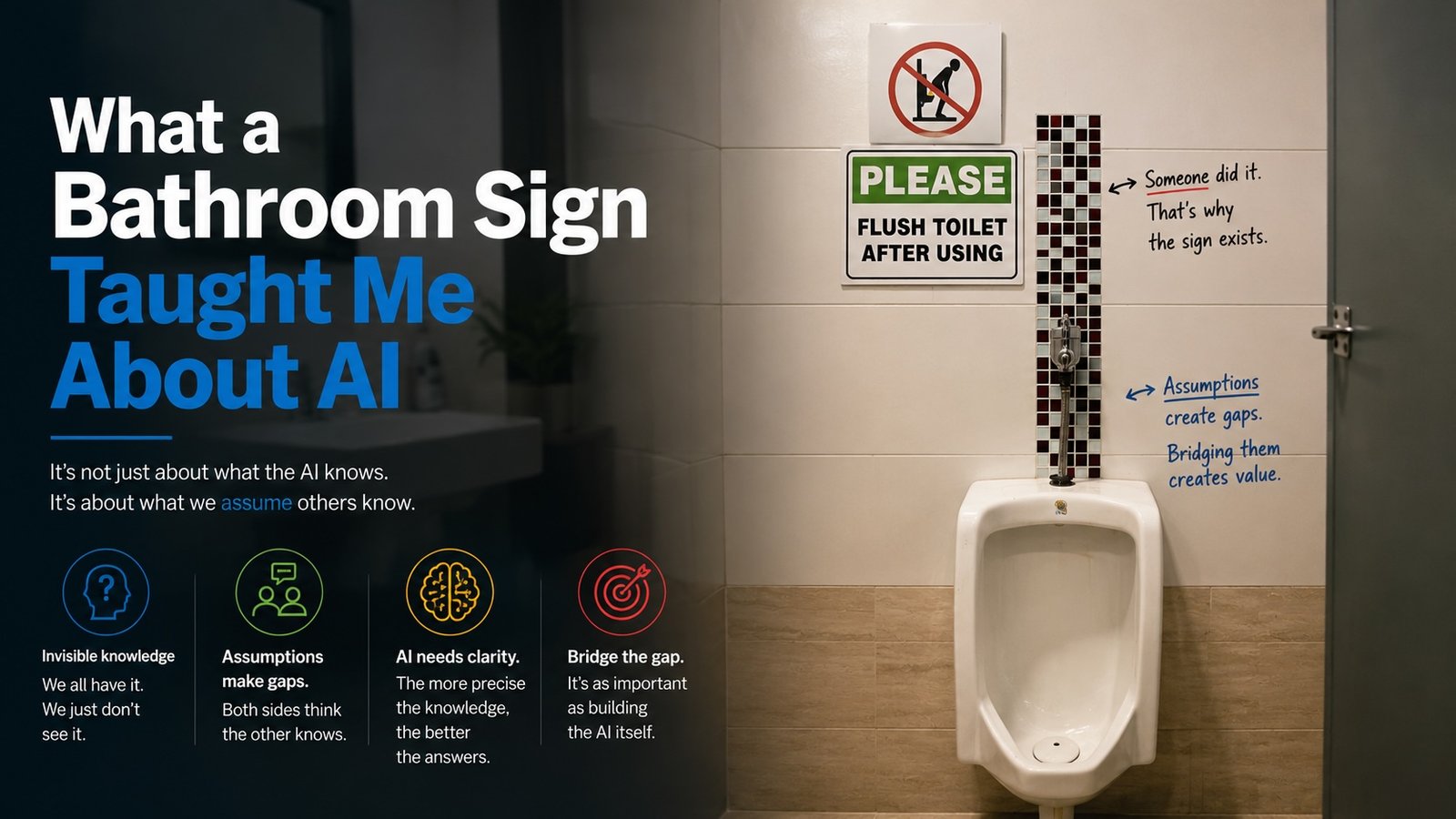
I came across a sign recently that made me smile.
It read:
“Do not poo in the urinal.”
My first reaction was probably the same as yours.
“Surely nobody needs to be told that.”
Then I caught myself.
The sign exists because somebody did.
As amusing as it was, it reminded me of something much more important.
We often assume something is common knowledge simply because it feels obvious to us.
More often than not, it isn’t.
I Made Exactly the Same Mistake
A few days later, I was conducting a client presentation on AI.
Part way through the session, I realised I had made an assumption.
I’d been talking about ChatGPT and corporate AI assistants as though everyone naturally understood the difference between the two.
To me, it felt like basic knowledge.
After all, I spend almost every day working with AI.
I know why a public AI tool behaves differently from an AI that’s been built using an organisation’s own knowledge. I know why one can answer general questions while the other can provide company-specific guidance. Those distinctions have become second nature.
But then I looked around the room.
Not everyone was following the conversation in quite the way I had expected.
I realised I had skipped an important step.
I should have established a common starting point before moving into the details.
The mistake wasn’t theirs.
It was mine.
I had been looking at the conversation through my own lens instead of theirs.
Expertise Has a Hidden Cost
One of the curious things about becoming experienced in any field is that we gradually forget what it’s like not to know.
The concepts we’ve repeated hundreds of times become obvious.
The terminology becomes second nature.
The connections between ideas become automatic.
Eventually, we stop noticing that we’ve accumulated years of invisible knowledge.
It’s no longer something we consciously think about.
It’s simply how we see the world.
That’s true whether you’re a hotelier, an accountant, an engineer, a lawyer or an AI consultant.
Every profession develops its own shortcuts.
Every industry has words that mean something very specific to insiders but something completely different to everyone else.
Because we’re immersed in our own world every day, we forget that other people aren’t.
AI Has Made Me Notice This More Than Ever
One of the unexpected things I’ve discovered while implementing AI is that it exposes these hidden assumptions remarkably quickly.
When organisations prepare knowledge for their AI, they’ll often write information the way they would explain it to another colleague.
It makes perfect sense to everyone inside the business.
Until you ask someone outside the organisation to read it.
Or until the AI tries to answer a customer’s question.
That’s when the assumptions begin to surface.
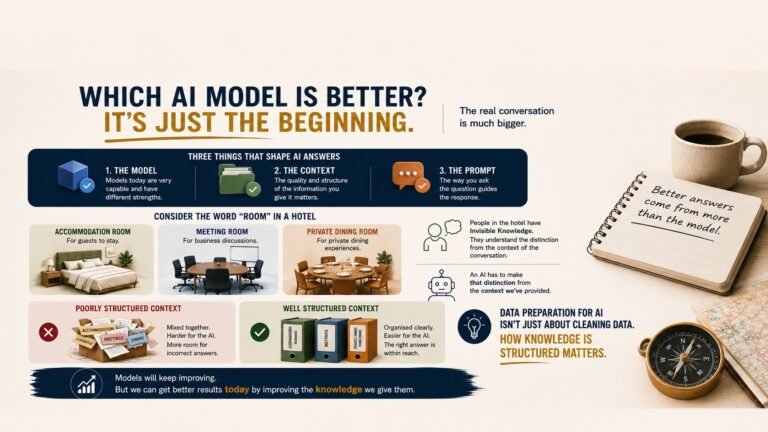
A hotel might describe a destination as being “about ten minutes away.”
Ten minutes by what?
Walking?
Driving?
During peak-hour traffic?
An employee immediately understands what was meant.
A customer may not.
An AI certainly doesn’t know which interpretation to choose.
The issue isn’t that the information is wrong.
It’s that it relies on knowledge that was never made explicit.
The Same Gap Exists Between People
That made me realise something.
When we talk about AI, we spend a lot of time discussing the knowledge the AI needs.
We spend far less time thinking about the knowledge gap between ourselves and the people we’re trying to help.
Whether it’s a customer.
A new employee.
A client.
Or an audience attending a presentation.
We constantly assume they know more than they actually do.
Sometimes they do.
Often they don’t.
The challenge isn’t simply transferring information.
It’s recognising which assumptions we’re making without even realising it.
The Context Gap
Over the years, I’ve started thinking of this as a context gap.
It’s the gap between what one person knows and what another person assumes they know.
Interestingly, it’s not unique to AI.
It exists in almost every business conversation.
A salesperson assumes the customer understands industry terminology.
A manager assumes a new employee understands company culture.
An engineer assumes everyone interprets a technical specification the same way.
A consultant assumes a client understands the concepts being presented.
Most misunderstandings don’t happen because people aren’t intelligent.
They happen because both sides are operating with different context.
AI Doesn’t Create the Gap
It Reveals It
One of the biggest lessons AI has taught me is that it rarely creates new problems.
It simply makes existing ones impossible to ignore.
If your organisational knowledge relies on unwritten assumptions, AI will expose them.
If different departments use different terminology, AI will expose that too.
If customers regularly misunderstand a product or service, AI conversations will reveal the pattern.
That’s why I often say AI isn’t just a technology project.
It’s an organisational learning project.
Every interaction teaches us something about our customers.
Every misunderstanding tells us where clarity is missing.
Every unexpected question reveals another piece of invisible knowledge that needs to be documented.
Building AI Means Building Shared Understanding
When organisations begin an AI project, they often focus on choosing the right model or the right platform.
Those decisions matter.
But they’re rarely the hardest part.
The harder challenge is helping everyone share the same understanding.
Making assumptions explicit.
Replacing vague language with precise knowledge.
Explaining concepts that insiders take for granted.
Creating information that both humans and AI can understand consistently.
That work benefits far more than the AI.
It improves onboarding.
It improves customer communication.
It improves collaboration between departments.
It improves the organisation itself.
Final Thoughts
That sign in the restroom made me laugh.
But it also reminded me of an important lesson.
Nothing is obvious to everyone.
The moment we assume something is common knowledge, we risk leaving someone behind.
I’ve come to realise that many AI projects don’t struggle because the technology is difficult.
They struggle because both sides assume the other already knows things they don’t.
Bridging that gap is every bit as important as building the AI itself.
Because the best AI projects don’t just make machines smarter.
They help organisations communicate more clearly—with their customers, with their employees and, sometimes, with themselves.