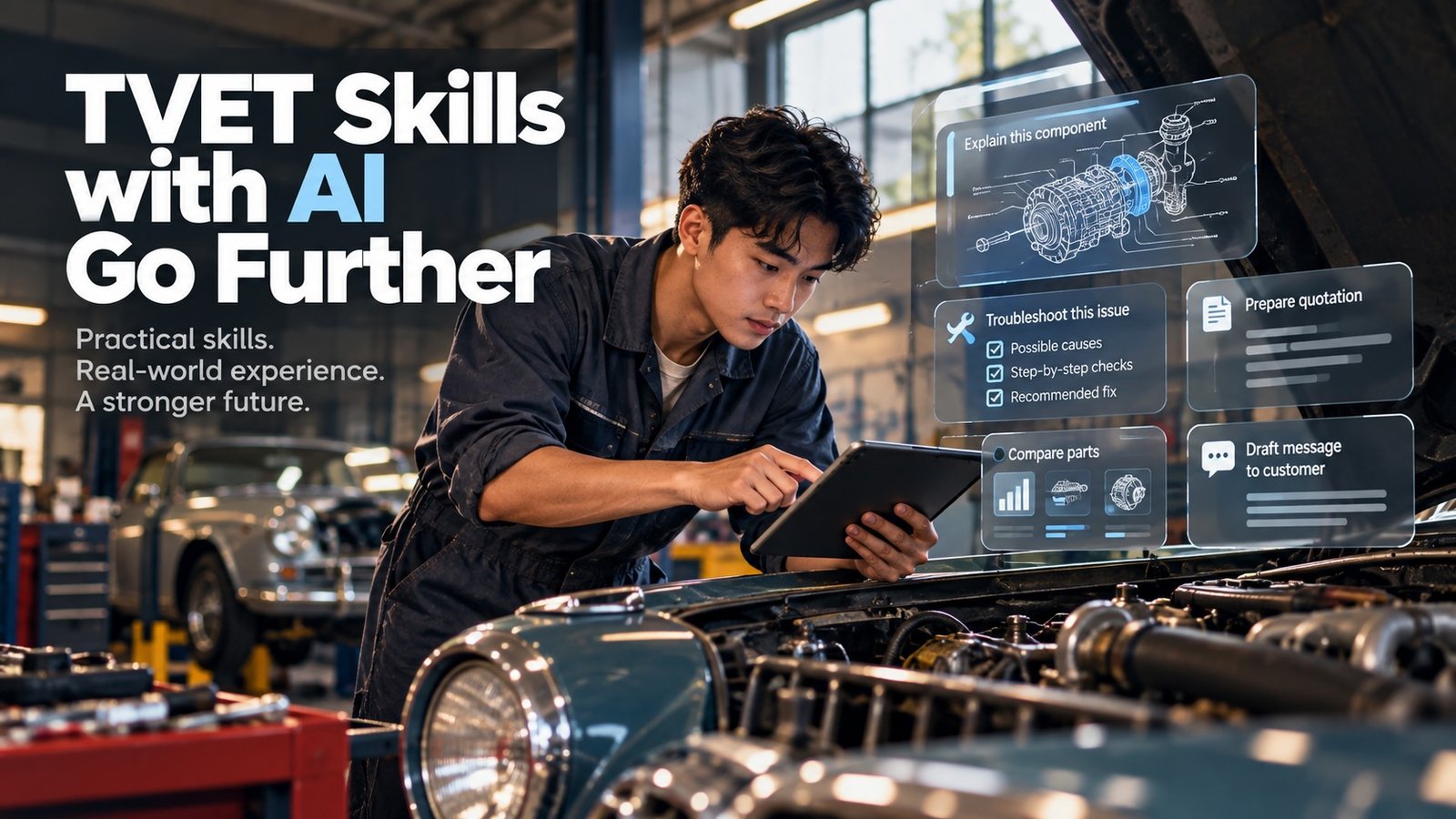
University + AI or TVET + AI?
I overheard an interesting conversation while having dinner recently.
Two gentlemen at the next table were talking about their teenage sons and what they should do after school.
One of them said that with AI now, there was no longer any need for their children to go to university.
I don’t share that view.
But I also couldn’t entirely fault them for asking the question.
Because GenAI is changing something fundamental about how we access knowledge, how quickly we can learn and, increasingly, what people are capable of doing without spending years acquiring knowledge in the way previous generations did.
Perhaps the more interesting question isn’t whether AI makes university unnecessary.
Perhaps we should be asking whether AI gives us an opportunity to rethink what a good education pathway can look like.
And one possibility I think deserves considerably more attention is:
TVET + AI.
University Was Never Just About Getting a Job
I’ve always felt that university should be about much more than preparing someone for employment.
It should broaden how we think.
It exposes us to people with different backgrounds, experiences and ideas.
It gives us opportunities to debate, question assumptions, make mistakes and discover subjects we might never otherwise encounter.
Done well, university develops more than knowledge.
It develops the person.
There are also many professions where university education remains essential. We wouldn’t want someone becoming an engineer, doctor or other regulated professional simply because they had spent enough time asking an AI questions.
So I don’t find the argument that AI somehow makes university obsolete particularly convincing.
But there’s another side to the discussion.
For too long, we’ve sometimes treated university as the default definition of educational success.
Perhaps AI gives us another reason to challenge that assumption.
What Happens When Practical Skills Meet AI?
Imagine a young person choosing electrical work.
Or automotive.
Manufacturing.
Mechatronics.
Machining.
Industrial maintenance.
Another technical or vocational field.
They develop the practical skills needed to perform the work properly.
They understand the equipment.
They know how things fit together.
They learn safety, procedures and standards.
Most importantly, they learn by actually doing.
Now add AI to that capability.
Not simply teaching them how to prompt ChatGPT.
Teach them how to use AI as part of their profession.
An electrician encountering an unfamiliar problem could use AI to help interpret technical documentation or work through possible causes before applying their own training and judgement.
Someone running a small automotive workshop could use AI to prepare quotations, explain repairs more clearly to customers, manage appointments and analyse recurring problems.
A technician could use AI to understand a new piece of equipment, compare documentation or prepare a maintenance report.
Someone in manufacturing could use AI to analyse information, document processes, troubleshoot issues or learn about unfamiliar systems.
The vocational skill gives them the ability to do.
AI potentially expands what they can do with that skill.
The Combination Is More Interesting Than Either One Alone
This is where I think TVET + AI becomes particularly interesting.
AI without real-world competence has limitations.
An AI can explain how something works, but that doesn’t mean the person reading the answer knows how to perform the work safely or recognise when something isn’t right.
Practical expertise still matters.
Experience still matters.
Human judgement still matters.
But practical expertise combined with AI creates a different kind of worker.
Someone who can work with their hands but also access knowledge quickly.
Someone who understands the physical problem but can use AI to investigate alternatives.
Someone who can perform the technical work but also communicate professionally with customers.
Someone who might be technically skilled enough to work for another company while also having the digital capability to eventually run a business of their own.
That’s a powerful combination.
AI Could Also Change How Vocational Workers Learn
There’s another part of this that I find exciting.
Learning no longer necessarily stops when formal education ends.
Imagine a technician five years into their career encountering equipment they’ve never worked with before.
Previously, learning might depend on finding the manual, attending another course, asking a more experienced colleague or searching through videos and forums.
Those resources remain valuable.
But AI can increasingly become another layer in that learning process.
It can help explain unfamiliar terminology.
Summarise lengthy documentation.
Translate technical information.
Generate questions to investigate.
Compare approaches.
Help someone prepare before speaking to a specialist.
The person still needs to determine whether the information is reliable and appropriate, particularly where safety is involved.
But the ability to learn continuously becomes much more accessible.
Perhaps one of the most important skills we can give young people therefore isn’t simply what they know when they graduate.
It’s the ability to keep learning after they graduate.
This Isn’t University Versus TVET
I wouldn’t frame this as a competition.
University + AI could be an incredibly powerful combination.
So could TVET + AI.
They develop different capabilities and suit different people, professions and ambitions.
What I think needs to change is our assumption that one pathway is inherently more successful than the other.
A young person who becomes highly competent in mechatronics and knows how to use AI intelligently may have an extraordinary set of capabilities.
So might a university graduate who combines deep domain knowledge, critical thinking and AI.
The important part is the combination.
We May Need to Rethink What AI Education Means
This also makes me wonder whether we’re defining AI education too narrowly.
Teaching young people how to use a chatbot isn’t enough.
Neither is teaching them a collection of prompts.
The tools will change too quickly.
What matters more is learning how to use AI alongside a real capability.
How do I use AI to investigate a problem?
How do I know when its answer might be wrong?
How do I verify information?
How do I use it to explore alternatives?
How do I combine what the AI knows with what I know from experience?
When should I trust my own judgement?
When should I ask someone with greater expertise?
And how can I use these tools to keep improving at what I do?
Those skills matter whether someone graduates from a university or a vocational college.
Perhaps the Question Isn’t Whether University Is Still Necessary
I still wouldn’t tell those two fathers at the next table that their sons don’t need university because AI exists.
That decision is far more complicated.
But their conversation made me think.
AI is changing access to knowledge.
It’s changing what individuals can accomplish.
And it’s likely to change the skills people need throughout their working lives.
Perhaps our response shouldn’t be to declare one traditional educational pathway obsolete.
It should be to create more powerful pathways.
University + AI is one.
TVET + AI could be another very powerful one.
And perhaps the most important thing isn’t which pathway a young person chooses.
It’s whether they emerge from it knowing how to think, do, learn and continue adapting as the tools around them change.