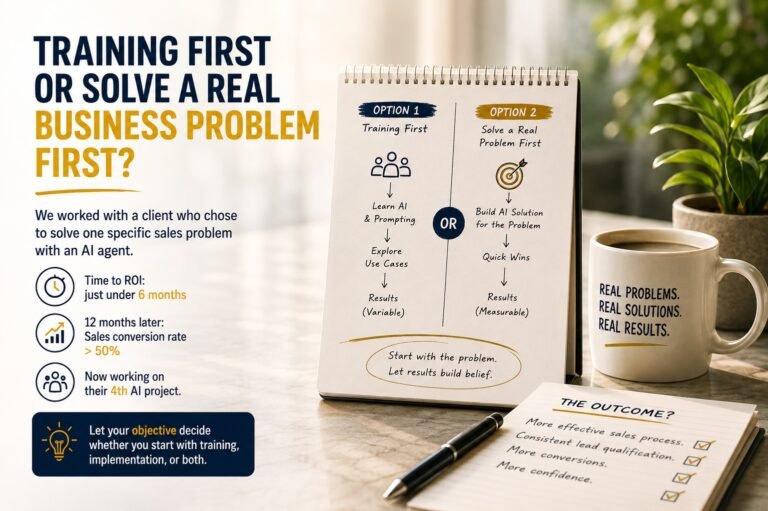

Don’t Let AI Become the Goal
One of the things I enjoy most about mentoring founders is that the conversations are rarely about technology.
They’re about decisions.
Recently, one of my mentees was excited about adding AI to his app.
He was convinced it would increase usage.
I smiled and told him he was probably right.
An AI feature would almost certainly make the app more engaging for the people who were already using it.
But then I reminded him of something.
“What was the objective you set for yourself?”
He paused for a moment before answering.
“To increase the adoption of my service.”
And that’s where the conversation changed.
App Usage and Business Growth Aren’t the Same Thing
It’s surprisingly easy to confuse activity with progress.
More app usage sounds like success.
More clicks, more conversations and more engagement all look like positive metrics.
But they’re only valuable if they move the business closer to its actual goal.
In my mentee’s case, the goal wasn’t to make the app more interesting.
The goal was to help more people discover and start using his service.
Those are two very different challenges.
AI might improve the experience for existing users.
It wouldn’t necessarily bring in new ones.
We Were Solving the Wrong Problem
Instead of asking, “How do we add AI?”
We stepped back and asked a different question.
“How do more people discover your business?”
That led us down a completely different path.
Rather than investing immediately in an AI feature inside the app, we discussed whether a mobile-friendly website should come first.
A website could be indexed by search engines.
It could appear when people searched for the services he offered.
It could be shared with a simple link.
Potential customers could explore what the business did without first committing to downloading an app.
In other words, it solved the problem that mattered most at that stage of the business.
The AI could still be part of the roadmap.
It just didn’t have to be the next milestone.
AI Is Exciting. That’s Also Its Biggest Trap.
We’re living through one of the most exciting periods in technology.
Every week there’s a new AI model.
A new feature.
A new capability.
A new success story.
It’s very easy to look at all of that and conclude that the answer to every business problem is, “Let’s add AI.”
Sometimes it is.
Often, it isn’t.
I’ve found that AI has a way of pulling our attention towards what is possible instead of what is necessary.
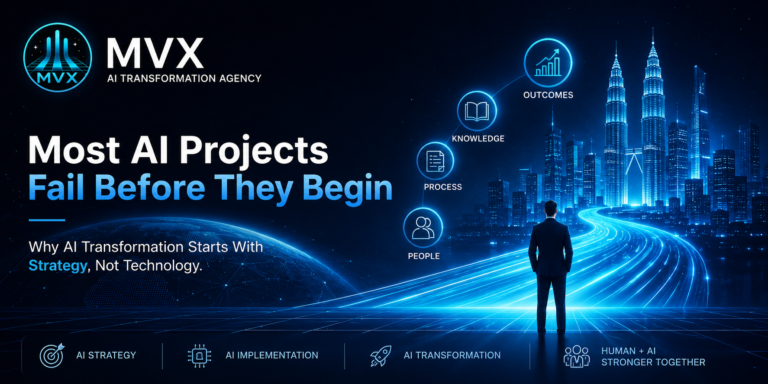
That’s why I believe strategy matters more than technology.
Technology gives you options.
Strategy helps you choose the right one.
Start With the Objective
When organisations approach us about AI, one of the first questions I ask isn’t about software or models.
It’s much simpler.
“What are you trying to achieve?”
Do you want to generate more leads?
Improve customer service?
Reduce response times?
Increase repeat business?
Help employees work more efficiently?
Each objective may lead to a very different solution.
Sometimes that solution includes AI.
Sometimes it starts with improving a website, simplifying a process or documenting organisational knowledge.
AI is incredibly powerful.
But it’s still only one tool in a much larger business strategy.
Good Strategy Makes the Next Step Obvious
One lesson I’ve learned over the years is that choosing what to build next becomes much easier when you’re clear about what success looks like.
Without a clear objective, every new technology looks attractive.
With a clear objective, many ideas naturally fall away because they don’t move the business forward.
That’s exactly what happened during that coaching session.
We didn’t reject AI.
We simply recognised that there was another step that would create greater impact first.
Final Thoughts
One of the biggest misconceptions about digital transformation is that it’s driven by technology.
I don’t think it is.
I think it’s driven by clarity.
Clarity about where the business is today.
Clarity about where it wants to go.
And clarity about which investment creates the greatest value right now.
AI is changing the way we build businesses, and I’m incredibly optimistic about what it can do.
But the most valuable conversations I have with business leaders are rarely about choosing the latest technology.
They’re about making sure we’re still solving the right problem.
Because when you’re clear about the objective, deciding what to build next becomes much simpler.