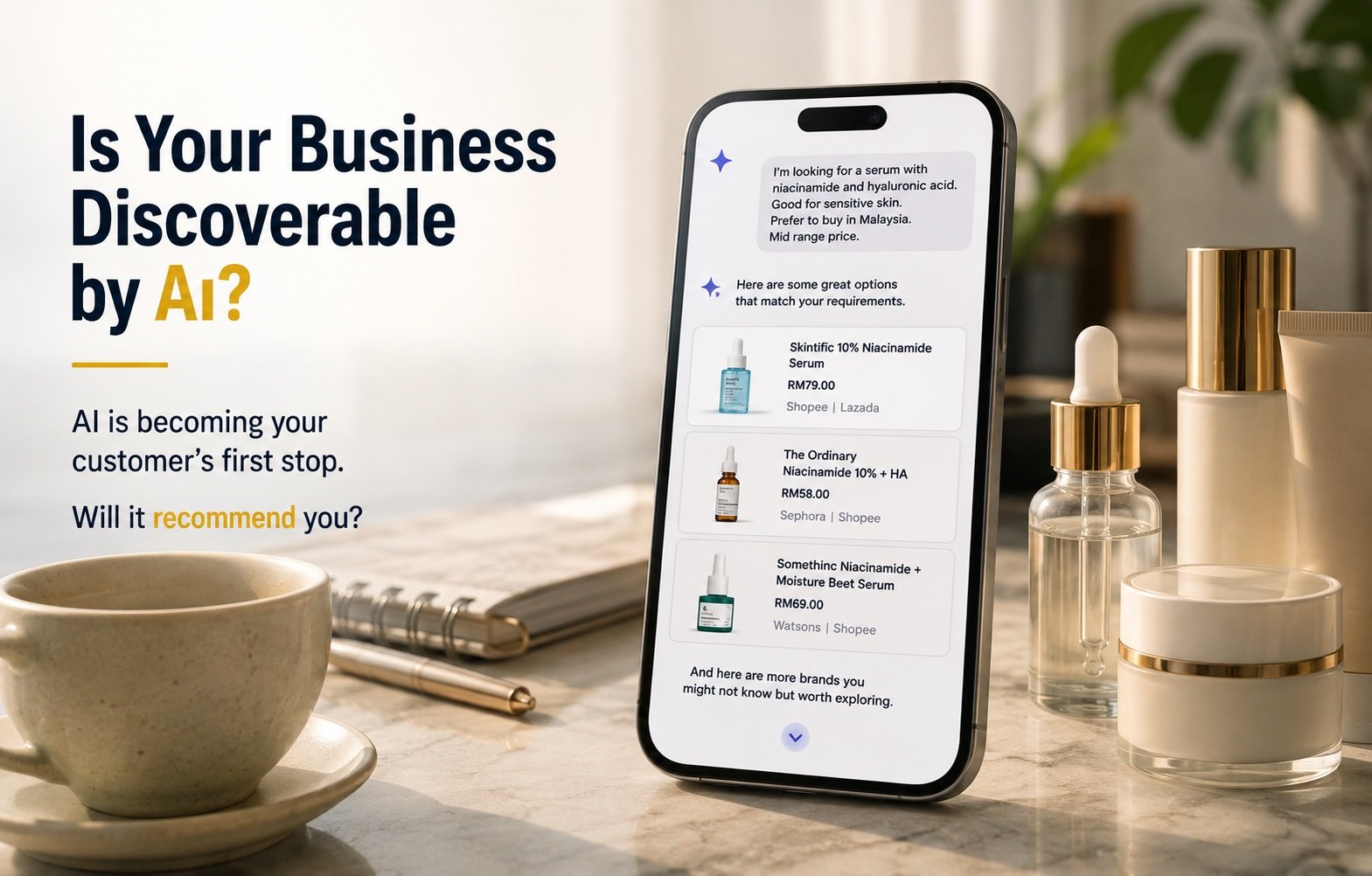
AI Is Becoming Your Customer’s Personal Shopper
Something my wife said over the weekend caught my attention.
She looked up from her phone and said,
“AI is my personal shopper now.”
She was looking for a cosmetic product.
Years ago, that would probably have meant opening a browser, searching Google, reading reviews, jumping between websites and comparing products one by one.
Instead, she opened an AI assistant.
She described what she was looking for.
The ingredients she preferred.
The skin concerns she wanted to address.
Her preferred places to shop.
Even her budget.
Within seconds, AI recommended several products that matched her requirements.
But what surprised her wasn’t that it found suitable products.
It was that many of the brands were completely new to her.
The Customer Journey Has Quietly Changed
That conversation stayed with me.
Not because AI recommended cosmetics.
But because it reminded me that the way people discover products is changing.
For years, businesses have focused on one important question:
“How do customers find us?”
The answer usually revolved around search engines.
Invest in SEO.
Run Google Ads.
Create content.
Improve your website.
Those things still matter.
But I think we’re entering a new phase.
Increasingly, customers won’t just search.
They’ll ask.
Instead of typing:
“Best moisturiser for sensitive skin.”
They’ll ask:
“I’m looking for a moisturiser with hyaluronic acid that’s suitable for sensitive skin, under RM150 and available in Malaysia. What would you recommend?”
That’s no longer a search query.
It’s a conversation.
And AI is becoming part of that conversation.
AI Doesn’t Think Like a Search Engine
Traditional search engines return pages.
AI returns recommendations.
That’s an important distinction.
My wife wasn’t looking for websites.
She wasn’t interested in comparing ten different online stores.
She wanted someone to narrow the choices for her.
In many ways, AI behaved like a knowledgeable sales consultant.
It listened.
It understood her preferences.
It filtered the options.
Then it explained why each recommendation was suitable.
That’s exactly what a good salesperson would do.
What Happens If AI Doesn’t Know Your Business Exists?
As I watched this happen, one question kept coming back to me.
What if your products aren’t part of that conversation?
Imagine you’re a retailer with an excellent product.
Competitive pricing.
Outstanding customer service.
Strong reviews.
But AI can’t find enough information about it.
Or it doesn’t understand what problem your product solves.
Or your website doesn’t clearly explain its features.
Or your content simply isn’t available for AI to understand.
Your business hasn’t suddenly become worse.
But it has become harder to recommend.
That’s a very different problem from traditional SEO.
Visibility Is Becoming Discoverability
For years, businesses have competed for visibility.
How high do we rank on Google?
How many visitors reach our website?
How many people click on our ads?
Those questions are still relevant.
But another question is becoming equally important.
Can AI confidently recommend your business?
Can it explain what you do?
Can it describe your products accurately?
Can it compare your offering with alternatives?
Can it understand who your ideal customers are?
If the answer is no, you may be invisible in an entirely new kind of buying journey.
Your Website Is No Longer Just for People
One of the biggest mindset shifts I think businesses need to make is recognising that their website is no longer written solely for human visitors.
Increasingly, it’s also becoming a source of knowledge for AI.
Your product descriptions.
Your FAQs.
Your service pages.
Your case studies.
Your articles.
Together, they help AI understand your business.
The clearer and more structured that information is, the better AI can explain what you do when someone asks the right question.
In other words, your website isn’t simply attracting visitors anymore.
It’s teaching AI how to talk about your business.
The Opportunity for Businesses
This isn’t something businesses should fear.
I think it’s an opportunity.
Smaller brands now have a chance to appear alongside much larger competitors if they communicate their value clearly.
That’s exactly what happened with my wife’s search.
AI introduced her to brands she’d never heard of.
Not because they had the biggest advertising budget.
But because they matched what she was looking for.
That’s encouraging.
It suggests the future may reward businesses that explain themselves well, not just businesses that spend the most on marketing.
Final Thoughts
My wife probably didn’t intend to spark a business conversation when she said,
“AI is my personal shopper now.”
But that’s exactly what happened.
Because that simple observation highlights a much bigger shift.
Customers are no longer relying solely on search engines to discover products and services.
Increasingly, they’re asking AI to help them decide.
For businesses, that means the question is changing.
It’s no longer just:
“Can my customers find me?”
It’s becoming:
“Can AI find me, understand me and confidently recommend me?”
Because in the years ahead, being discoverable won’t simply be about ranking on a search results page.
It will be about becoming part of the conversation before your customer even visits your website.