Why AI Projects Fail
I often speak to business owners, CEOs, department heads and managers who want to explore AI.
Some want a chatbot.
Some want to automate processes.
Some simply feel a sense of urgency because everyone around them seems to be talking about AI.
What strikes me is that many of these conversations begin with technology.
And that is often where things start going wrong.
The companies that achieve the greatest success with AI rarely begin by asking which AI platform to buy or which model to use.
Instead, they start with a much more important question:
“How do we become a better organisation?”
Because despite what many people think, AI is not a business strategy.
It is not a shortcut.
And it is certainly not a magic wand.
AI is an accelerator.
It amplifies what already exists within your organisation.
If your business is well organised, AI can help you move faster.
If your customer experience is strong, AI can help you scale it.
If your knowledge is documented and accessible, AI can help your people leverage it more effectively.
But if your organisation is struggling with fragmented processes, knowledge silos and inconsistent customer experiences, AI will expose those weaknesses just as quickly.
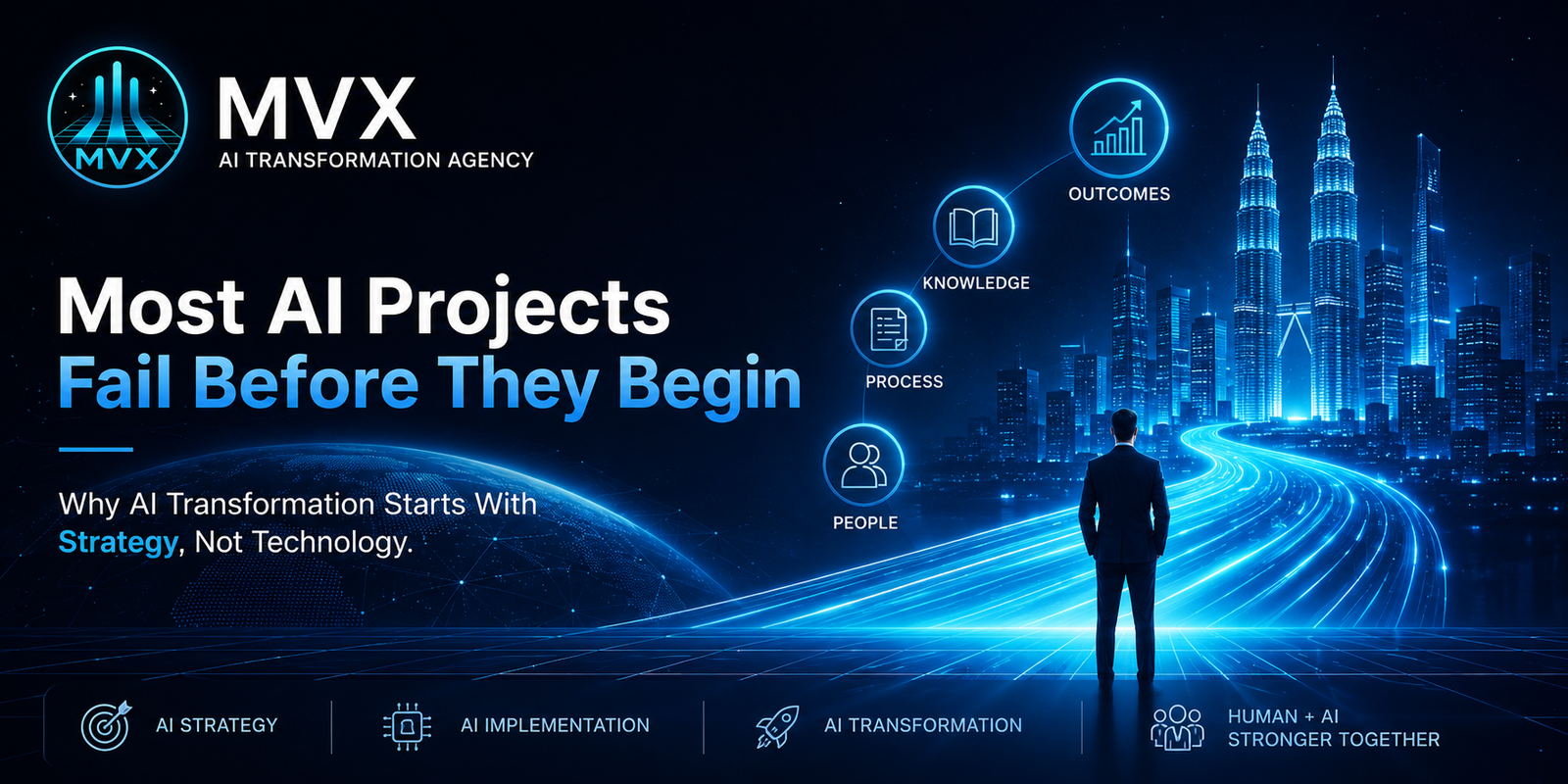
This is why I believe many AI projects fail before they even begin.
Not because the technology is wrong.
But because the organisation isn’t ready.
Most Businesses Don’t Have an AI Problem
They Have a Knowledge Problem
One of the most common things I encounter when working with organisations is that valuable knowledge is trapped inside people.
The person who has been with the company for fifteen years knows how things work.
The sales manager knows the answers customers are looking for.
The operations team knows which exceptions to make and when.
The customer service staff know how to solve recurring issues.
The problem is that much of this knowledge never gets captured.
It exists in conversations.
Emails.
WhatsApp messages.
Spreadsheets.
And inside the heads of experienced employees.
Humans are surprisingly good at navigating this environment.
AI is not.
When organisations tell me they want to implement AI, one of the first questions I ask is:
“How much of your business knowledge has actually been documented?”
Because AI can only work effectively with information it can access.
If your organisation’s expertise isn’t captured, structured and maintained, AI will have very little to build upon.
This is why I often tell clients that before they have an AI strategy, they need a knowledge strategy.
The Goal Isn’t to Replace People
The goal is to make people more valuable.
One of the narratives surrounding AI is that it will replace jobs.
While there will undoubtedly be changes in how work gets done, I think many organisations are asking the wrong question.
Instead of asking:
“How many people can we replace?”
A better question might be:
“How can we help our people spend more time creating value?”
Most businesses have talented employees spending a significant portion of their day handling repetitive tasks.
Answering the same questions.
Searching for information.
Qualifying enquiries.
Scheduling appointments.
Following up on routine requests.
These tasks are important, but they are not necessarily where people create the most value.
AI can handle many of these repetitive interactions quickly and consistently.
That allows employees to focus on what humans do best.
Building relationships.
Solving problems.
Understanding context.
Making judgement calls.
Creating trust.
The organisations that see the greatest benefits from AI are often the ones that use it to amplify their people rather than replace them.
Customer Experience Is Where AI Creates Real Value
If there is one place where AI can create immediate impact, it is customer experience.
Customers today expect fast responses.
They expect information to be available when they need it.
They expect businesses to be responsive.
Unfortunately, many organisations struggle to meet these expectations consistently because their teams are already stretched.
This is where AI can play an important role.
Not by replacing the customer-facing team.
But by supporting it.
We’ve seen situations where AI handles the initial engagement, answers common questions, gathers information and qualifies enquiries before passing the conversation to a human team member.
The customer receives immediate attention.
The employee receives a better-qualified conversation.
The organisation delivers a better overall experience.
One of our clients achieved a booking conversion rate of around 70% using this approach.
Not because AI replaced people.
But because AI and people worked together more effectively.
That distinction matters.
AI Transformation Is Not a Technology Project.
It Is a Leadership Project.
The organisations that succeed with AI do not treat it as an IT initiative.
They treat it as a business transformation initiative.
The conversations move beyond software and technology.
They become conversations about:
- Customer experience
- Organisational capability
- Knowledge management
- Productivity
- Employee empowerment
- Scalability
In other words, they become leadership conversations.
Technology plays an important role.
But technology is only one part of the equation.
The real challenge is helping the organisation adapt, learn and evolve.
The Businesses That Will Benefit Most From AI
Won’t Necessarily Be The Most Technical
There is a common assumption that the companies that will benefit most from AI will be those with the biggest technology budgets.
I am not convinced that is true.
I believe the organisations that will benefit most are those that are willing to learn.
Those that are willing to document their knowledge.
Those that are willing to improve their processes.
Those that are willing to rethink how work gets done.
Those that are willing to empower their people.
AI rewards organisational maturity.
The better your foundations, the greater the impact AI can have.
Final Thoughts
Whenever someone asks me how they should approach AI, my answer is usually the same.
Don’t start with the technology.
Start with the business.
Start with your customers.
Start with your people.
Start with your knowledge.
Understand what kind of organisation you want to become.
Then ask how AI can help you get there.
Because AI is not the transformation.
It is the accelerator.
The transformation begins with the decisions leaders make long before the technology arrives.